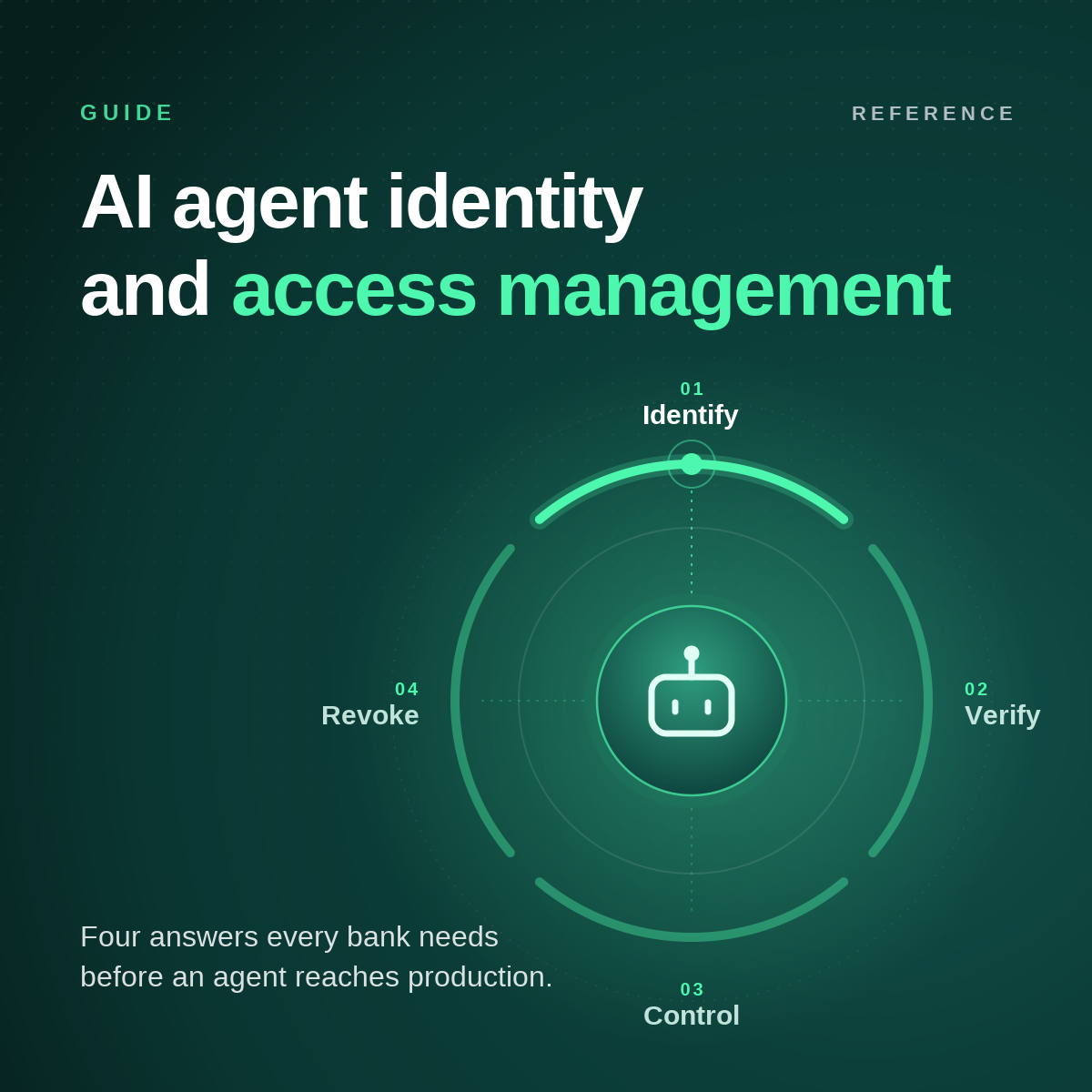
AI agent identity and access management is how an organisation gives each AI agent a verifiable identity, records whose authority it carries, bounds what it may ask for, and withdraws that authority when something changes. It extends identity and access management, which was built for people and for software with a fixed call pattern, to software that chooses what to do next.
Four questions sit under every agent access decision. Identify: which copy of the software is asking. Verify: who stands behind it. Control: what may it do, and for whom. Revoke: how do you change your mind later. A bank that can answer all four with signed evidence can put agents into production. One that cannot will keep them in pilots, which is where most agent programmes in financial services are today.
Before any agent reaches production
Four answers, with signed evidence
- 01Identify / which copy is asking
- 02Verify / who stands behind it
- 03Control / what it may do for this customer
- 04Revoke / how you change your mind later
Raidiam Connect publishes, outside the request path. Your server decides.
This guide covers what each answer has to carry, which published standards already solve part of it, where the remaining work sits, and what evidence to ask for before approving agent access. It is written for architects, identity and security teams, and the people who sign off agent programmes in regulated institutions.
Contents
- 1. What is AI agent identity and access management?
- 2. Agent, release, instance
- 3. Why banks hit this first
- 4. Why existing IAM does not cover AI agents
- 5. How an AI agent authenticates
- 6. What an AI agent is permitted to ask for
- 7. Resolved, not registered: agent identity across domains
- 8. The AI agent identity lifecycle
- 9. Withdrawal, revocation and freshness windows
- 10. Know your agent: audit and evidence
- 11. An AI agent governance framework
- 12. What a bank's risk committee will ask
- 13. Agents acting for a customer: payments and purchases
- 14. When the agent belongs to the customer
- 15. Architecture and components
- 16. Choosing an AI agent identity platform
- 17. Where Raidiam Connect fits
- 18. Find out where your bank stands
- 19. Further reading
- 20. Frequently asked questions
What is AI agent identity and access management?
AI agent identity and access management is the set of controls that gives each AI agent its own identity, binds that identity to a key the agent holds, records the authority it has been granted and by whom, bounds every request against that authority, and makes the whole chain readable by a system that has never seen the agent before.
It differs from human IAM in what it has to prove. A person authenticates once and carries a session. An agent arrives at a system that may have no record of it, presents evidence about itself, and has to be evaluated on the spot against statements signed by someone the receiving system already trusts.
The scale is already large. Machine identities, including AI agents, outnumber people 109 to 1, according to Palo Alto Networks’ 2026 Identity Security Landscape.
It differs from traditional machine identity in what it has to bound. A service account runs fixed code and the set of calls it will make is known in advance. An agent decides which tool to call, often from data it read a moment earlier, so permissions cannot be set by listing the calls.
Agent, release, instance: three things that get conflated
Agent, release and instance are three different things with different lifecycles, and most confusion about agent identity comes from treating them as one. For a worked introduction, see establishing trust in agentic AI.
| Object | What it is | Has an identity? | Has a version? |
|---|---|---|---|
| Agent | The governed identity. An entity with its own identifier, its own authority chain, roles, marks, keys and lifecycle state. It exists because somebody decided it does. | Yes | No |
| Release | A versioned build of agent software: artefact, digest, SBOM, the tools it offers, its purpose. Signed by its publisher. | No. Nothing resolves it. | Yes |
| Instance | One running copy of that agent. A key generated in the process, an attestation binding that key, and an entry on a signed list of copies. | No address of its own | No |
The test is whether anybody can reach it. A thing with an address publishes a signed document at that address, so a stranger can resolve it, read who vouches for it and check it. That is an entity and it gets an identity. A thing with no address cannot be resolved, so it is attested instead.
Three things that get conflated
Agent
The governed identity
- Has an identifier
- Has an authority chain
- Has no version
Release
The software
- Has a version
- Has a digest and SBOM
- Has no identity
Instance
One running copy
- Has a key
- Has an attestation
- Has no address
Can anybody reach it? If yes, it is an entity. If no, it is attested.
This matters in practice, and it matters most at a bank. Stopping an instance leaves the identity alone. Publishing a new release does not change the agent. Withdrawing the agent takes the authority away from every instance of it. Three different acts with three different blast radii, and a control framework that uses one word for all three will not survive second-line review.
Why banks hit this first
Banks run into agent identity earlier and harder than most sectors, for four reasons that have nothing to do with how advanced their AI programmes are. For the wider picture, see how agentic AI in financial services is changing the operating model. Across sectors, organisations already had more than 80 machine identities for every person in 2025, according to CyberArk’s 2025 Identity Security Landscape.
- The boundaries are already regulated. An agent crossing from a retail division to a payments platform crosses a control boundary that already has an owner, an audit trail and a regulator interested in it. In most industries that crossing is an architecture decision. In a bank it is a control decision with a named accountable person behind it.
- The approval gate exists and has teeth. Second-line risk already reviews access to customer data. An agent programme does not get to defer the question, and the review will ask for evidence rather than assurances.
- The estate is fragmented by design. Legal entities, regulated and unregulated subsidiaries, separate clouds, outsourced platforms and third-party providers. Agents create value by working across those boundaries, which is exactly where identity and authority stop travelling.
- Customers are already asking. Retail customers want to use their own AI assistant with their accounts. That is a new channel arriving from outside the bank’s control, on a timetable the bank did not set.
The result is a pattern that shows up in almost every institution: a pilot that works and cannot reach production data, because nobody can say who the agent is, who authorised it, or what it is allowed to do. The article Twenty pilots, nothing in production covers that blocker in business language for programme owners and budget holders.
Where agents cross a boundary in a bank
| Use case | The boundary it crosses | What breaks without agent identity |
|---|---|---|
| Credit review pack preparation | Relationship team to credit systems | The credit API cannot establish whose authority the assistant carries |
| Corporate treasury assistant | Client organisation to bank platform | No way to prove the agent acts for an authorised signatory, within limits |
| Payment initiation on a customer's instruction | Customer device to payments platform | No way to bound one instruction, so it becomes standing access |
| Insurance claims triage | Claims to policy and customer data | Scope inherited from a human's full permission set |
| Fraud and risk investigation | Risk to transaction and customer records | Audit stops at a shared service account |
| Staff productivity assistants | Business unit to business unit | Every team builds its own pattern and IAM inherits six of them |
| Third-party or vendor agents | Partner organisation to bank API | Manual onboarding per agent, which does not scale past a handful |
Why existing IAM does not cover AI agents
Existing IAM does not cover AI agents because identity providers were built around a person who can be challenged: a password, a second factor, a consent screen. None of those apply to software. API gateways enforce traffic policy and validate tokens, and they are good at it, but a gateway cannot establish who issued an identity it has never seen or whether that identity is still vouched for right now.
Three gaps show up as soon as an agent programme moves past the first use case.
- Shared credentials. Ten agents built by one team use one service account. No downstream system can tell them apart, and withdrawing one withdraws all ten. This is the most common failure and the one that blocks second-line approval.
- Authority that does not survive the hop. A task passes from an assistant to a specialist agent to a tool to an API, each step issuing its own token. By the fourth system, the authority the person originally granted has been replaced by whatever the third system decided to ask for.
- Boundaries nobody owns. Inside one cloud account with one identity provider the problem is manageable. The moment an agent calls a service governed by another business unit, another cloud or another organisation, the receiving side has to decide whether to trust an identity it did not issue, and no central registry settles that, because no party will hand registration control to another.
The article Agent API security when one AI agent calls another follows a single credit-review request through five steps and shows exactly where the information is lost.
How an AI agent authenticates
An AI agent authenticates by presenting its own identifier and proving it holds the matching private key, rather than by presenting a shared secret.
In the pattern Raidiam runs, the agent calls a platform with its identifier and a client assertion signed with its authentication key, using private_key_jwt. The platform has no client record for that agent beforehand. It resolves the identifier instead. Three things follow from signing rather than sharing:
- A leaked log file does not yield a usable credential, because the proof is a signature over a fresh assertion rather than a reusable secret.
- Two agents from the same team present different identities to the same API, because each holds its own key.
- The platform can bind what it issues to the key that asked for it, using mutual TLSand certificate-bound or DPoP-bound tokens, depending on the deployment.
OAuth 2.0 provides the authorisation machinery. It does not define what an agent is, who operates it, or whether a given delegation chain should be accepted. Those are governance decisions that sit above the protocol, which is why “we use OAuth” is not an answer to the agent identity question at an approval gate.
Where the running copy matters, a separate mechanism covers it. The instance generates a key in process, an attester checks it, binds that key, maps the instance to its approved client and publishes an entry on a signed list of copies. The instance presents that client instance attestation at the token endpoint. This is what lets a platform distinguish an approved agent from one particular running copy of it, which a credential on its own cannot do. For a retail bank it is the difference between approving an assistant and approving the copy running on one customer’s laptop. See software identity and attestation.
The trust check
From first contact to a bounded token
What is checkedClient record on your platform: none needed in advance.
What is checkedDoes the walk reach the pinned anchor? If not, the request stops here.
What is checkedAny required mark is checked for signature, and its status is asked of its issuer.
What is checkedAn access token, for a stated lifetime: 300 seconds on the public showcase.
What an AI agent is permitted to ask for
Agent authorisation works by bounding what an agent may ask for, then narrowing that to what a single request actually names.
The useful distinction is between the envelope and the grant. The envelope is everything the agent could ask for across all of its work. The grant is what this one request gets. Three bounds sit between them.
- Registered. What the authority that governs the agent has said it may ask for. The agent cannot write this itself. It is published in a statement signed by the agent’s superior, which is why a stranger reads that statement rather than taking the agent’s word.
- Attested. Where an attester vouches for a running copy, what that copy is approved for. Where there is no attester, attested equals registered.
- Granted. What this request named, checked against the two bounds above. Everything outside the request stays outside the token.
From envelope to grant
Three ceilings, each narrower
Registered / what the authority says it may ask for
- records.read
- records.annotate
- transfer.initiate
- transfer.status
Attested / what this running copy is approved for
- records.read
- records.annotate
Granted / what this request named
- records.read
Everything outside the request stays outside the token.
For a bank the practical effect is that approval to prepare one credit review pack does not become standing access to the credit book, and a customer approving a look at last month’s spending does not hand over payment initiation. The token carries the types the request named and nothing else, for a short, stated lifetime.
Scope cannot be a list of endpoints. Because an agent chooses its own calls, the bound has to be expressed as a policy the platform folds at request time rather than an enumeration fixed at issuance. More on the data side in API security and AI agents.
Prompt injection sits outside this. Identity and authorisation controls do not stop an agent being persuaded to try something. They decide what happens when it does, which is that the request falls outside the ceilings and no token is issued for it. That is containment, and it is worth saying plainly to a risk committee rather than overclaiming.
Resolved, not registered: agent identity across domains
Cross-domain agent identity means a platform can establish who an agent is, who vouches for it and whether that is still true, without having been given a record of that agent in advance.
Two patterns exist. A central registry lists every approved agent. It works inside one legal entity and fails across organisational boundaries, because no party will hand registration control to another, and because the list goes stale the moment anything changes.
Federated resolution works differently. Each domain governs its own agents and publishes signed statements about them. The receiving platform walks from the agent’s identifier up through its authority to an anchor whose key that platform already holds in configuration. If the walk reaches the pinned anchor, the chain is readable. If it does not, the request stops there.
Walk the chain
Resolved, not registered
Trust anchor
Group trust anchor
Publishes Its own entity configuration. Its key is pinned in your platform's configuration.
Proves the chain ends somewhere you chose to trust. Proves nothing about the agent on its own.
Authority
Retail division authority
Publishes A subordinate statement about the agent: its keys, policy, roles and any marks.
Proves who vouches for the agent and on what terms. Does not prove the agent is behaving well.
Agent
Credit review assistant, retail division
Publishes Its own entity configuration, with authority_hints pointing upward.
Proves the agent holds its key. Does not prove anyone vouches for it.
Trust anchor
Your trust anchor
Publishes Its own entity configuration. Its key is pinned in your platform's configuration.
Proves the chain ends somewhere you chose to trust. Nothing about the partner is pinned.
Your authority
One recognition record for the partner's root
Publishes A signed statement recognising the partner's root once, with the ceiling every agent under it is checked against.
Proves you chose to recognise this partner and on what terms. Mints nothing for the partner.
Partner root
The partner's own root and keys
Publishes A subordinate statement about its agent: its keys, policy and roles.
Proves the partner vouches for its agent. The partner keeps its own root, keys and software.
Agent
Treasury agent, partner company
Publishes Its own entity configuration, with authority_hints pointing upward.
Proves the agent holds its key. Does not prove anyone vouches for it.
Your platform
Pins the anchor’s key, then walks up from the agent. If the walk reaches the pinned anchor, the chain is readable. If not, the request stops.
Switch the scenario. Either way, the walk ends at the one anchor you pin.
OpenID Federation 1.0 is the published specification behind this. It is not a Raidiam protocol and not an agent framework. It resolves trust between parties, which is the part of the agent problem that no gateway and no identity provider solves. Read more on OpenID Federation for scalable trust and on building access control for agentic AI with OpenID Federation.
For a bank the saving shows up in partner integrations. Recognise the partner’s root once. Every agent under that root resolves without a new record, a new integration or a new approval cycle. One record per partner root rather than one per agent. The same holds between the bank’s own legal entities, which is usually where the first hard case appears.
The practical test: can a partner’s agent call your API, and can your platform establish who issued that agent’s identity, whose authority it carries and whether it is still vouched for, without your team having pre-registered it by hand.
The AI agent identity lifecycle
AI agent identity management runs across six stages: identify, attest, govern, discover, authorise and revoke. Most institutions can do the first and struggle with the rest.
| Stage | What happens | What to ask for at the approval gate |
|---|---|---|
| Identify | The agent gets its own identifier and a record with an owner, a purpose, the tools it offers and the environments it runs in | The inventory itself. Most banks cannot produce one today |
| Attest | Keys are bound. Where running copies matter, an attester binds each copy's key and publishes its entry on a signed list | The key binding method and the credential lifetime |
| Govern | A named person grants roles and records the intent. The authority publishes a signed statement carrying those roles, the policy and any marks | The accreditation record and who signed it |
| Discover | A platform that has never seen the agent resolves it on first contact, walking the chain to an anchor it pins | Which anchors each platform pins, and who controls them |
| Authorise | The platform issues short-lived tokens bounded by the ceilings, carrying only what the request named | A sample token and what it carries |
| Revoke | Roles change, marks are withdrawn, copies are stopped, the agent is withdrawn. Each consumer applies it at its next read | A stated freshness window and what each consumer does when the answer expires |
A catalogue entry is software that could become an agent. It confers nothing on its own. The governed identity exists because somebody decided it does, and that decision is the thing that gets published, read and checked.
Withdrawal, revocation and freshness windows
Withdrawal, revocation and stopping an instance are three different acts, and using one word for all of them causes real operational errors in a regulated estate.
- Withdraw the agent. The authority stops publishing the statement that vouches for it. Every consumer stops accepting it at its next read.
- Revoke a credential. A certificate or a token is invalidated. This affects that credential, not the agent’s authority.
- Stop an instance. One running copy ends. The agent identity is untouched and other copies carry on. A lost laptop is this case, not the other two.
There is no kill switch, and claiming one to a risk committee will not survive the first question. Each consumer applies a change at its next read, inside a window it states in advance. Raidiam’s public showcase states 300 seconds, for example. The guarantee an institution can actually make is “withdraw once, and every consumer reads again when its answer expires”, with the window written down.
Short credential lifetimes do the rest of the work. A token that expires in minutes limits exposure more reliably than any review cycle.
Two status words are worth getting right. Withdrawn means a source answered and is deliberately publishing nothing. Unknown means the source did not answer or could not be checked. Treating Unknown as Withdrawn creates outages. Treating it as valid creates incidents. It needs its own policy, agreed before go-live.
Know your agent: audit and evidence
An audit record for an agent request should let someone reconstruct, after the fact, who initiated the task, which agents were in the chain, what authority each carried, what the request named, and what the platform decided.
If the record stops at “service account X called API Y at 14:32”, the agent programme will not survive second-line review, and it will not answer a regulator asking who authorised a particular customer data access. Four things the record should carry:
- The initiating person or organisation
- Each agent in the chain and the authority each resolved to
- The ceilings in force and what the request named
- The decision, and where a required mark’s status was read from and when
“Not read” is not the same as zero. A platform that did not check a mark’s status should record that it did not, rather than recording a clean pass. Published trust registries are what make that status readable by a stranger.
An AI agent governance framework
AI agent governance is the set of decisions an institution makes about how agents get identities, who may grant them authority, what they may reach, and how that is withdrawn and evidenced. The identity controls above are the mechanism. The governance framework is who decides and on what basis.
Five control domains cover it: issuance, delegated authority, scope, revocation and audit. Raidiam has published the full control set, with what good looks like in each domain, what evidence to ask for at the approval gate, and how it maps to published regulatory guidance. Read the full framework: AI agent governance framework for banks approving agent access.
Quick self-check
Which areas need the most work?
- 01
Issuance
Each agent has its own identity, with an owner on record.
- Does each agent present its own identity, rather than a shared service account?
- Can you list which agents hold credentials for production systems?
- 02
Delegated authority
The receiving system can see whose authority the agent carries.
- Can the receiving system check whose authority an agent is acting on?
- Can it verify how that authority was delegated?
- 03
Scope
Permissions are bounded per request, not inherited.
- Are an agent's permissions narrower than the person's who authorised it?
- When one agent hands work to another, are the permissions narrowed?
- 04
Revocation
Withdrawal reaches every system within a stated window.
- Does one withdrawal reach every system within a window you have tested?
- Does withdrawing an agent also withdraw access delegated under it?
- 05
Audit
Every request can be reconstructed after the fact.
- Could you show who authorised a past agent action, and which permissions applied?
- Can you identify the running copy that made a call?
Answer every question to see which domain would hold your agents back.
Get the full readiness assessmentThere is no finished industry control catalogue for agent access yet. The NIST NCCoE concept paper (February 2026) on identity and authorisation practices for software and AI agents is a draft for comment and describes the problem space rather than a control set. The UK FCA’s position is that existing frameworks and governance expectations already apply to AI, including Consumer Duty and the Senior Managers and Certification Regime. In the UAE, the Central Bank has published guidance on the responsible adoption of AI and machine learning by licensed financial institutions. The joint Five Eyes guidance on agentic AI (2026) calls for distinct cryptographic identities for agents, a trusted registry, identities bound to authorised roles, and least privilege. Treat all of them as inputs to an internal control set rather than a substitute for one.
The practical consequence for a bank is that the agent control set sits alongside model risk management, operational resilience and third-party risk rather than replacing any of them. Agent identity answers the access question. It does not answer whether the model behind the agent is fit for the task, and conflating the two slows both reviews down.
What a bank’s risk committee will ask
A bank’s risk committee will ask who decides, what happens when something fails, and where the evidence is. Five questions come up every time, and an agent architecture that cannot answer them will not get through.
- Who makes the access decision? The bank’s own authorisation server should. A trust layer publishes signed statements for that server to read. If the vendor’s platform sits in the request path and decides, that is a different architecture with a different risk profile, and it should be identified as such early.
- Where does customer data go? Account data should travel between the agent and the bank’s own APIs, with the trust layer outside the request path.
- What happens if the trust layer is unreachable? Your server decides on the answers it already holds, until its freshness window ends. Software it has not seen before waits. Any answer other than this one means an external dependency on the live path.
- What happens if we stop using it? The exit should be the entry in reverse. Pins, keys and configurations stay with the bank.
- Where is the assurance? Policies, certifications and audit reports, named and current. ISO 27001, SOC 2 Type II and PCI DSS are the usual floor for this kind of component.
For the risk paper
AI agent access: the five questions
- Who decides?
- The bank's own authorisation server. The trust layer publishes signed statements for it to read.
- Where does the data go?
- Between the agent and the bank's own APIs. The trust layer is outside the request path.
- If the trust layer is unreachable?
- The server decides on the answers it holds until its freshness window ends. Unseen software waits.
- If we stop using it?
- The exit is the entry in reverse. Pins, keys and configuration stay with the bank.
- Where is the assurance?
- Named, current policies, certifications and audit reports. ISO 27001, SOC 2 Type II and PCI DSS as the floor.
Prepared from the AI agent access readiness assessment.
Agents acting for a customer: payments and purchases
When an agent acts for a customer in a transaction, the receiving system needs three things beyond the agent’s own identity: that a person authorised this specific action, what the limits of that authorisation are, and that the authorisation has not already been used or withdrawn.
This is the same delegated authority problem with a tighter boundary. A standing mandate is the wrong shape. The authorisation has to name the transaction, carry a short lifetime, and be checkable by the party on the other side of the payment.
The standards work here is unsettled and moving. Agent payment authorisation proposals are live across several bodies, and anyone picking a pattern now should expect to revise it. What is stable is the underlying requirement: an identifier for the agent, a signed statement of who granted the authority, a bound on what it covers, and a status source that can be asked.
When the agent belongs to the customer
The sharpest version of this problem in retail banking is a customer’s own AI agent reaching the bank’s APIs through a connector running on the customer’s device. That request arrives with the customer’s permission, no client record at the bank, and no identity the bank can check. And it is never one request: every customer who connects runs their own copy, on their own device, each needing different access.
The four answers hold, and the unit of control is the copy rather than the application. The bank lets in that one copy, for that one customer, with a read-only token only that copy can use. The customer approves on their own phone and picks which accounts to share. A lost laptop means stopping one copy while everyone else carries on.
Banks already connected to an open banking or open finance ecosystem have most of what this needs: the APIs, the security profile and the certificate-based trust. What gets added is short. The authorisation server resolves OpenID Federation statements, accepts the connector’s attestation, and issues DPoP-bound tokens. The AI agent governance solution page sets out how a bank lets a customer’s own agent in, and the interactive walkthrough follows one agent through every system it touches.
Architecture and components
A working AI agent IAM architecture has six parts: a catalogue, an authority, a trust anchor, an attester, an authorisation server and an API gateway. Most banks already own four of them.
| Component | Role | Usually owned by |
|---|---|---|
| Catalogue | Where software is approved for deployment | The bank. Stays as it is |
| Authority | Publishes signed statements, marks and policy about the agents it governs | New. This is the gap |
| Trust anchor | The root whose key each consuming platform pins from configuration | New |
| Attester | Vouches for one running copy, binds its key, publishes its entry on a signed list | New where the running copy matters |
| Authorisation server | Resolves the agent, folds policy, issues the token | The bank. Adds three checks |
| API gateway | Enforces traffic policy and validates the token | The bank. Stays as it is |
The catalogue, the platforms and the approval processes stay where they are. What gets added is the authority, the anchor and, where running copies matter, the attester. Each platform adds three checks: resolve the chain, fold the policy, check the mark. The trust control plane is where the authority and anchor live, and the developer guide to secure agentic AI access walks through the setup.
Choosing an AI agent identity platform
AI agent identity platforms fall into five categories: identity providers extending to agents, workload identity platforms, non human identity governance, AI and API gateways, and cross-organisation trust layers that resolve identity across organisational boundaries.
Which fits depends mostly on one question: do your agents stay inside one legal entity, or do they cross into partners, separate clouds and separate entities. The first four categories handle the inside case well. The fifth exists because the crossing case is where they stop.
To separate them quickly, ask each vendor for three things: a four-hop worked example showing what the final API can establish about the initiating person, the acting agent and the limits of the delegation; the stated freshness window; and a sample audit record. The role of APIs underneath all of this is covered in APIs in the age of AI.
The full set of criteria, a scoring sheet and ten questions to put to any vendor are in our buyer’s guide, how to evaluate AI agent identity platforms.
Where Raidiam Connect fits
Raidiam Connect is trust infrastructure for non human identity. It publishes one governed record for each piece of software as signed statements on OpenID Federation, so a platform that has never met that software can resolve it, see who vouches for it and check whether that is still true.
Where Raidiam Connect sits
Connect publishes. Your server decides.
The request path: yours
AI agent
Presents its identifier and a signed proof
- Decides
Your authorisation server
Resolves the agent, applies your policy, issues the token
Your API gateway
Enforces traffic policy, validates the token
Your APIs and data
Answer the request
Read and cached by your authorisation server, inside a freshness window you state
The trust layer: outside the request path
Raidiam Connect
Publishes signed statements about each agent on OpenID Federation 1.0: who it is, who vouches for it, what it may ask for, and whether that is still true.
Partners and other domains
Publish their own statements. Recognised once, not registered agent by agent.
- Not in the request path
- Never makes the access decision
- Account data never passes through Raidiam
- Your catalogue, identity platform and gateway stay yours
Connect’s trust layer is not in the request path, and it does not make the access decision. Your authorisation server reads the signed statements, applies your policy and issues the token. Account data never passes through Raidiam. Your catalogue, identity platform, gateway and approval processes stay yours. See how Connect governs AI agents.
It is built on OpenID Federation 1.0, OAuth 2.0, X.509 and mutual TLS. No proprietary protocol. Where an authorisation server cannot yet resolve federation statements, accept a connector attestation or issue DPoP-bound tokens, Connect’s Identity & Access Management capability can act as the authorisation server, applying your policy. It never proxies or inspects API traffic. Connect integrates with Ping, ForgeRock and Keycloak on the identity side, and Kong, Apigee, AWS API Gateway and MuleSoft on the gateway side. An MCP connector brings agents into the same trusted network, so the MCP services a bank exposes check them the same way.
Production evidence
Raidiam has run trust frameworks in production since 2016: eight national trust frameworks, more than 2,000 organisations, 99.99% production uptime. Open Finance Brasil, the Central Bank of the UAE, ConnectID in Australia, GetVerified in New Zealand and UK Open Banking. Certifications: ISO 27001, SOC 2 Type II, PCI DSS 4.0, Cyber Essentials, and FAPI 2.0 for the Identity & Access Management capability. See the production trust frameworks.
The caveat, stated with the numbers: those figures are open banking and open finance traffic. None of it is agent traffic. Publishing the limit alongside the proof is what makes the proof usable in a bank’s own due diligence.
See it working on live infrastructure. The public showcase runs the full sequence on a fictional enterprise estate, with every claim linked to the evidence behind it, including the things the deployment does not demonstrate. The organisations and people in it are fictional.
Find out where your bank stands
The AI agent access readiness assessment shows how ready your organisation is to give AI agents access to production systems. It shows which access controls you already have, which are missing or hard to evidence, and what to fix first. No sales call attached to it.
Further reading
The articles and developer posts below go deeper on the topics in this guide, from the business case for agent identity to the technical detail of federation and trust registries. Everything technical is also in the Raidiam developer portal.
- GuideHow to evaluate AI agent identity platformsFive categories of platform, twelve criteria with a test for each, a scoring sheet and ten vendor questions.
- GuideAPI security checklist for AI agent accessTwenty-two checks across authentication, authorisation, delegation, lifetime and withdrawal, and audit.
- GuideWhat is non human identity?Every kind of non human identity, the four controls that apply to all of them, and the software that covers each.
- ArticleHow to stop AI agents reaching data they should notThe five ways agents end up over-privileged, the control that closes each, and what prompt injection changes.
- ArticleFrom service accounts to AI agents: what actually changesWhat carries over from service account practice, the three places it stops, and a migration order.
- ArticleAgentic AI in banking: twenty pilots, nothing in productionWhy agent programmes stall before production, in business language for programme owners and budget holders.
- ArticleAI agent governance framework for banks approving agent accessThe full control set across five domains, with the evidence to ask for before you approve an agent.
- ArticleAgent API security when one AI agent calls anotherOne credit review request followed through five steps, showing where identity and authority get lost.
- ArticleAPI security and AI agents: safeguarding sensitive enterprise dataWhy AI agents raise the stakes for enterprise API security, and the standards that already help.
- ArticleFrom impersonation to delegation: agentic AI transforming financial servicesWhy agents should act under delegated authority of their own, and what that means for banks.
- ArticleUnlocking Smart Data in the age of AI: the enduring power of APIsWhy APIs and trust frameworks stay the foundation as AI agents arrive.
- Developer blogEstablishing trust in agentic AIThe technical case for giving every agent a verifiable identity.
- Developer blogBuilding access control for agentic AI with OpenID FederationHow federation statements and policy bound what an agent may ask for.
- Developer blogOpenID Federation: the missing link for scalable trustHow resolving signed statements replaces registering every party with every other.
- Developer blogTrust registries in scalable digital trustWhat a trust registry does and why status has to be readable by a stranger.
- Developer docsSecure agentic AI accessThe developer guide to setting up agent access with Raidiam Connect.
Frequently asked questions
What is AI agent identity and access management?
AI agent identity and access management is how an organisation gives each AI agent a verifiable identity, records whose authority it carries, bounds what it may ask for, and withdraws that authority when something changes.
How is agent IAM different from traditional IAM?
Traditional IAM assumes either a person who can be challenged interactively or a machine account with a fixed, predictable call pattern. An agent is neither. It chooses its own actions, hands work to other agents, and runs as many copies from one approved identity.
How do AI agents authenticate?
An agent presents its own identifier and a client assertion signed with a key it holds, rather than a shared secret. The receiving platform resolves that identifier through a signed chain to an anchor whose key it already holds, then decides what to issue.
Can OAuth handle AI agent authorisation on its own?
OAuth 2.0 provides the authorisation machinery. It does not define what an agent is, who operates it, or whether a given chain of authority should be accepted. Those decisions sit in the governance layer above the protocol.
What is OpenID Federation and why does it matter for AI agents?
OpenID Federation 1.0 is a published specification for establishing trust between parties by resolving signed statements up to a trust anchor, rather than by pre-registering every party with every other. It is the mechanism that lets a bank platform accept an agent it has never seen.
What is non human identity?
Non human identity covers every participant in an ecosystem that is not a person: applications, APIs, services, AI agents, wallets and devices. In most enterprises these outnumber human identities by ten to one or more.
How do you revoke an AI agent's access?
Three different acts. Withdraw the agent, and the authority stops vouching for it. Revoke a credential, and that certificate or token stops working. Stop an instance, and one running copy ends. Each consumer applies a withdrawal at its next read, inside a freshness window it states in advance.
Is there a kill switch for AI agents?
No, and any product claiming one is describing something else. What a bank can guarantee is withdraw once, and every consumer reads again when its answer expires, with the window written down and short credential lifetimes behind it.
What is the difference between an agent, a release and an instance?
The agent is the governed identity and has no version. The release is a versioned build of software and has no identity. The instance is one running copy, with a key and an attestation but no address of its own.
How do you prove which running copy of an agent made a call?
Through attestation. The instance generates a key in process, an attester checks it, binds that key and publishes an entry on a signed list of copies. The instance presents that attestation when it authenticates.
Does agent identity prevent prompt injection?
No. Prompt injection changes what an agent decides to try. Identity and authorisation controls decide what happens when it tries, which is that anything outside the ceilings gets no token. That is containment rather than prevention.
How do you manage AI agent identities across multiple clouds?
By governing each domain locally and resolving across them, rather than by maintaining a central list. Each cloud, business unit or partner publishes signed statements about its own agents, and every consuming platform walks the chain to an anchor it pins.
How do you govern AI agents that belong to a partner organisation?
Recognise the partner's root once. Every agent under that root then resolves without a new record on your side. One record per partner root rather than one per agent.
Can a customer use their own AI agent with their bank accounts?
Yes, if the bank can identify which copy of the software is asking, verify who vouches for it, control what it may do for that one customer, and stop that copy later. The copy is the unit of control, because every customer runs their own on their own device.
Does the trust layer decide what the agent can do?
No. It publishes signed statements. The bank's own authorisation server reads them, applies its policy and issues the token.
Does customer account data pass through the trust layer?
It should not. In the Raidiam pattern Connect is outside the request path, so account data travels between the agent and the bank's own APIs.
What happens if the trust layer is unreachable?
Your authorisation server decides on the answers it already holds, until its freshness window ends. Software it has not seen before waits.
What should I ask a vendor about AI agent identity?
Ask for a four-hop worked example showing what the final API can establish about the initiating person, the acting agent and the limits of the delegation. Ask for the stated freshness window. Ask for a sample audit record. Those three answers separate the categories quickly.
How do AI agents authenticate for purchases on behalf of a customer?
The receiving party needs the agent's identity, a signed statement of who granted the authority, a bound on what that authority covers, and a status source it can ask. Standards work in this area is live and moving, so expect to revise the pattern.
What regulations apply to AI agents in financial services?
There is no agent-specific control catalogue yet. The UK FCA's position is that existing frameworks already apply to AI. The UAE Central Bank has published guidance on responsible AI adoption by licensed institutions. NIST NCCoE has a concept paper out for comment. The joint Five Eyes guidance on agentic AI (2026) calls for distinct cryptographic identities for agents and a trusted registry.
About the author
Ralph Bragg, Co-founder and CTO, Raidiam
Ralph co-architected the trust infrastructure behind open banking in the UK and Brazil and is a named contributor to the OpenID Foundation's FAPI Working Group. Raidiam has run trust frameworks in production since 2016.