Why agent traffic is different
Agent traffic differs from the application traffic most APIs were designed for in three ways. The caller decides what to request instead of following a fixed path. One approved agent runs as many copies. And the agent is usually acting for somebody, so the API has to establish both who is calling and on whose behalf.
This checklist covers only what those three differences change. The general baseline, from rate limiting to input validation, is in our general API security checklist, and the enterprise view is in API security and AI agents. For the concepts behind each check, see our guide to AI agent identity and access management.
To see all three differences at once, explore our interactive walkthrough. You follow one agent around a galaxy of bank systems as it acts for a client’s treasurer, and watch each API decide what to let through.
The checklist
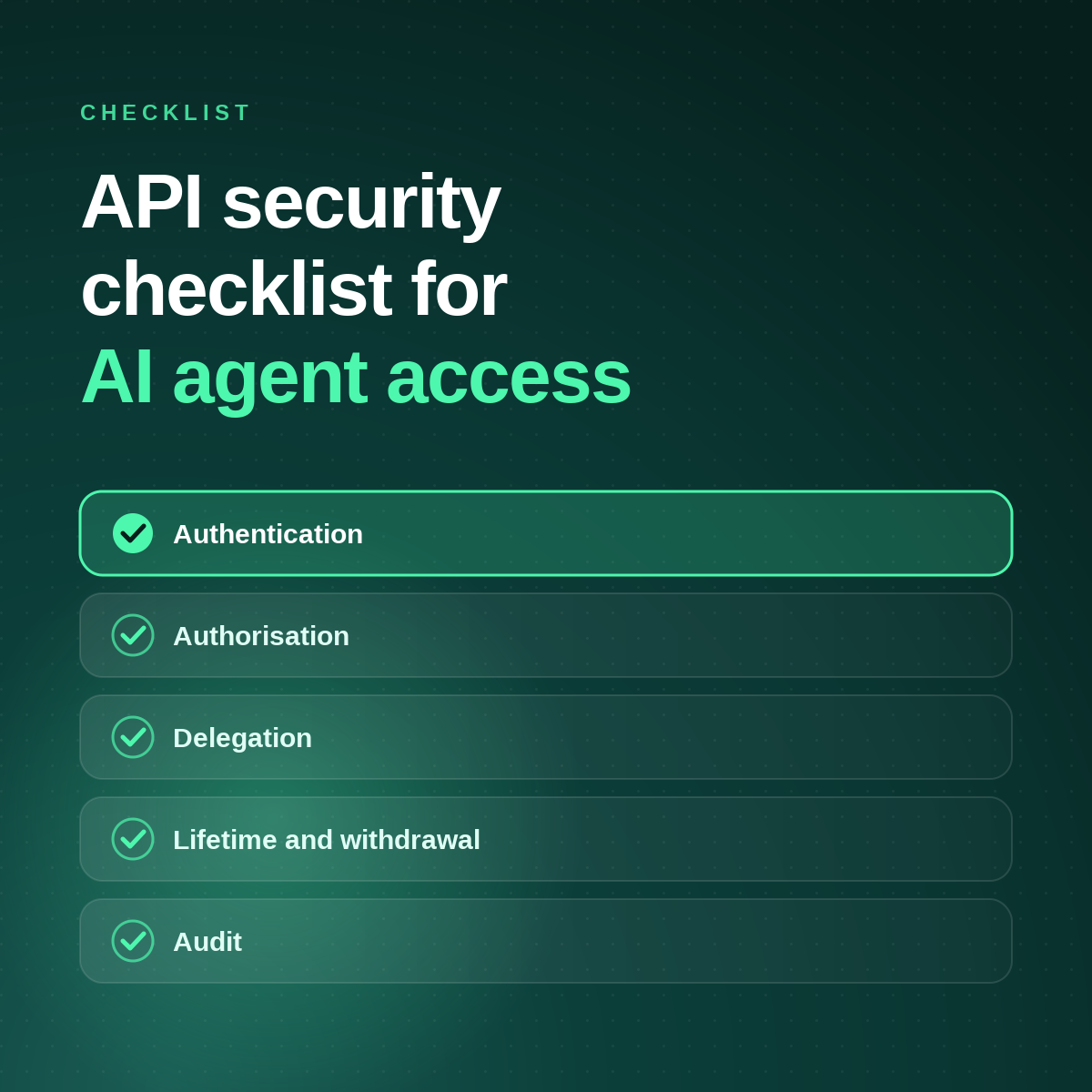
The checklist has 22 checks in five areas. Tick each one your API passes, using the test under it as the evidence.
Scorecard
Tick each check your API passes
Authentication5 checks
Authorisation5 checks
Delegation4 checks
Lifetime and withdrawal5 checks
Audit3 checks
Checks 2 and 15 build on practice your developers may already have. Our developer articles explain mutual TLS client authentication and key rotation, and our FAPI guide covers the financial-grade API security profile. Check 11 is the one most estates fail, and we follow it through a real request in agent API security when one AI agent calls another.
How to read your score
Your score shows whether the gaps are structural or a matter of configuration.
- Below 10: the API is not ready for agent traffic, and the gaps are structural. Start with checks 1, 2 and 17.
- 10 to 16: the authentication layer is probably sound and the delegation layer is not. Checks 11 to 14 are where most estates sit.
- 17 to 21: the remaining gaps are usually audit completeness and the policy for unknown status.
- 22: ask for the evidence behind each tick, then run check 20 against a real request.
Which standards cover which checks
Five published specifications cover most of the checks between them, and none covers all 22.
| Area | Published specifications |
|---|---|
| Authentication | OAuth 2.0 (RFC 6749), RFC 8705 certificate-bound tokens, RFC 9449 DPoP, FAPI 2.0 for financial-grade APIs |
| Cross-organisation acceptance | OpenID Federation 1.0 |
| Delegation | RFC 8693 OAuth 2.0 Token Exchange |
| Workload identity | SPIFFE |
| Portable claims | W3C Verifiable Credentials |
The building blocks are published and well tested. Assembling them is the part each organisation still does for itself. The OWASP API Security Top 10 remains the reference for the general baseline.
Frequently asked questions
What is an API security checklist for AI agents?
A list of checks an API should pass before AI agents call it, covering authentication, authorisation, delegation, credential lifetime, withdrawal and audit. It differs from a general API security checklist because the caller chooses its own actions and usually acts on someone's behalf.
How is securing an API for AI agents different from securing it for applications?
An application follows a fixed call pattern that can be listed in advance. An agent does not, so permissions have to be bounded by policy applied at request time. An agent also usually acts for a person, so the API has to establish both the caller and the authority it carries.
Do I need a new API gateway for AI agent traffic?
Usually not. The gateway keeps doing traffic policy and token validation. What gets added is the ability to resolve an identity issued elsewhere and to evaluate delegation evidence, which sits with the authorisation server.
What credential lifetime should an AI agent token have?
Minutes. A short lifetime limits exposure more reliably than a review cycle, because it does not depend on anyone noticing a problem.
How do I make my APIs ready for AI agents to consume?
Publish machine-readable metadata about the API and its authorisation requirements, accept sender-constrained credentials, evaluate delegation evidence as well as validating the token, and log every party in the chain.