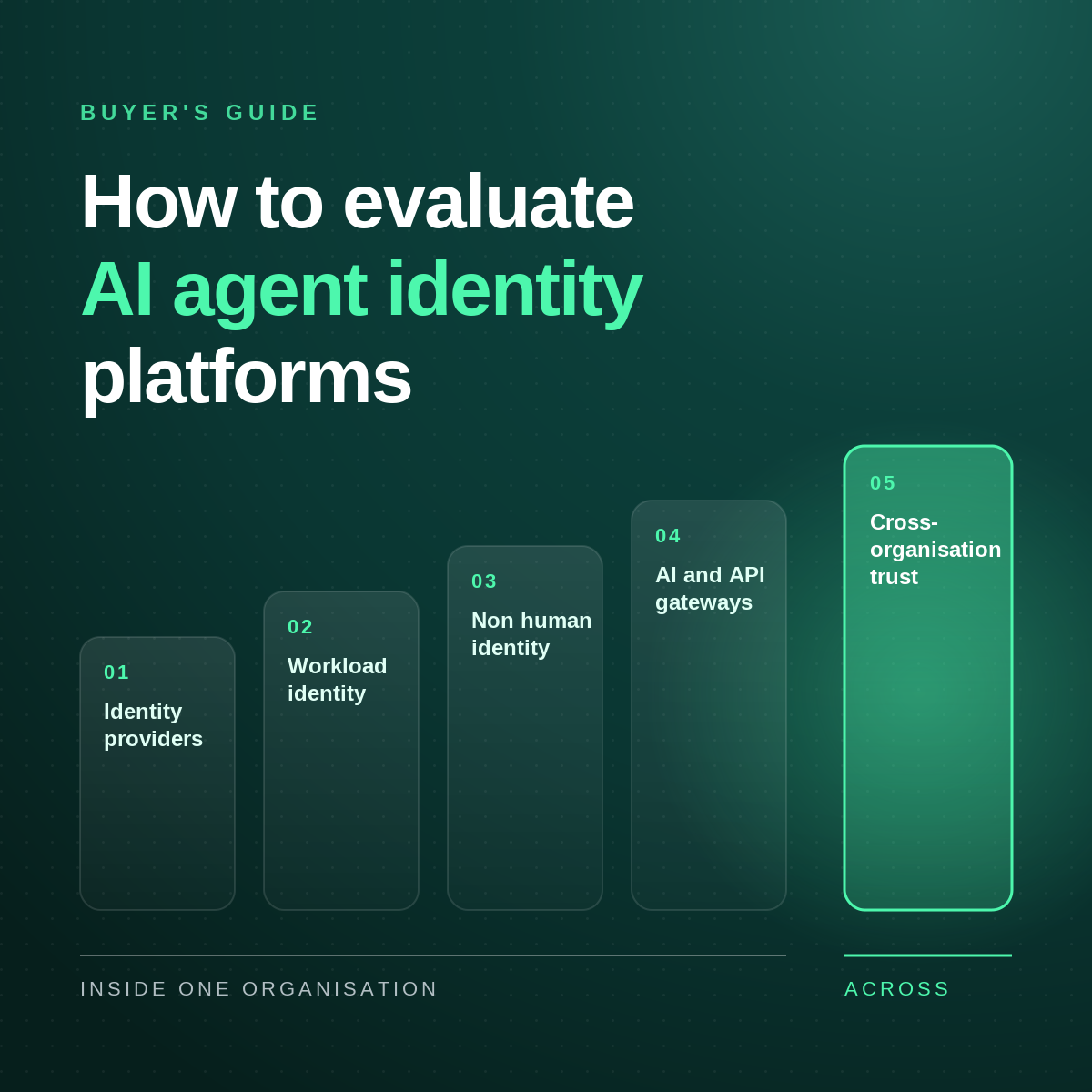
AI agent identity platforms fall into five categories, and which one fits depends mostly on one question: do your agents stay inside one organisation, or do they cross into partners, customers and separate legal entities. The first four categories handle the inside case well. The fifth exists because the crossing case is where they stop.
We have not ranked the vendors. Almost every comparison in this category is published by one of the vendors in it, and almost every one of those places its author at the top. A scoring sheet you fill in yourself is more use than someone else’s verdict. For the concepts behind each criterion, see our guide to AI agent identity and access management.
Five categories
Where each kind of platform works
- 01
Identity providers
Bring agents into the directory, lifecycle and access policies you already run.
- 02
Workload identity
Issue short-lived, policy-checked credentials so nothing holds a long-lived secret.
- 03
Non human identity governance
Discover the machine identities you have, map owners, flag over-privilege.
- 04
AI and API gateways
Enforce policy where the call happens, on API, model and tool traffic.
- 05
Cross-organisation trust layers
Establish who an agent is and who vouches for it, with no record in advance.
Inside one organisation
Across organisations
The five categories
The five categories of AI agent identity platform are identity providers extending to agents, workload identity platforms, non human identity governance, AI and API gateways, and cross-organisation trust layers. Each is described below in the terms its vendors use.
1. Identity providers extending to agents
Identity providers bring agents into the identity system the organisation already runs, so agents appear alongside employees in the same directory, lifecycle and access policies. Microsoft Entra Agent ID places agents inside Conditional Access and identity governance for Microsoft estates. Okta for AI Agents extends workforce identity to agents, and Okta has published Cross App Access, an open protocol for agent-to-application access. Ping Identity and SailPoint approach agents from access management and identity governance respectively.
Strongest fit: organisations with a mature identity programme and agents that stay within the estate that programme covers.
2. Workload identity platforms
Workload identity platforms issue short-lived, policy-checked credentials to workloads so nothing has to hold a long-lived secret. SPIFFE and SPIRE are the open standard and its reference implementation. Aembit applies workload identity to agent access with a secretless model. Teleport issues certificates to workloads and pipelines through Machine ID.
Strongest fit: engineering-led organisations already running cloud-native infrastructure, where the agent is one more workload.
3. Non human identity governance
Non human identity governance platforms discover the machine identities already in an estate, map ownership, flag over-privilege and manage the lifecycle. Astrix Security, Oasis Security, Token Security and Entro Security built this category. Consolidation has been fast: SailPoint completed its acquisition of Entro in June 2026, and Cyera signed a letter of intent to acquire Oasis in July 2026.
Strongest fit: organisations that cannot currently produce an inventory of their machine identities, which is most of them. Discovery is the right first purchase when you do not know what you have.
4. AI and API gateways
Gateways enforce policy at the point where the call happens, checking identity on API, model, tool and agent-to-agent traffic. Kong, Apigee, AWS API Gateway and MuleSoft serve this role for API traffic. Newer AI gateways add model and MCP traffic to the same enforcement point.
Strongest fit: organisations that want one enforcement point in the request path and already run a gateway.
5. Cross-organisation trust layers
Cross-organisation trust layers let a platform establish who an agent is, who vouches for it and whether that is still true, without having been given a record of that agent in advance. This is the smallest and youngest category. It uses OpenID Federation 1.0 to resolve signed statements up to a trust anchor, instead of maintaining a list. Raidiam Connect sits here.
Strongest fit: banks, insurers and ecosystem operators whose agents cross into partners, customers or separate legal entities.
The question that decides the category
The question that decides the category is this: can a partner’s agent, or a customer’s own agent, call your API, with your platform establishing who issued that agent’s identity, whose authority it carries and whether it is still valid, without your team having registered it by hand first.
If the answer does not need to be yes, categories one to four will serve you and you should buy from them. If it does need to be yes, you will need something from category five alongside whatever you already run, because a registry held by one party does not settle trust between two. That is the situation in how a bank lets a customer’s own agent in.
Most organisations need two purchases. Discovery comes first, because you cannot govern an inventory you do not have. Then comes whichever enforcement model matches where your agents actually go.
Twelve evaluation criteria
Twelve criteria separate AI agent identity platforms, and each has a test you can run in a demonstration. Run the test rather than reading the datasheet.
01Per-agent identity
Does every agent get its own identity, or do agents from one team share a service account?
Test: Ask for a demonstration of two agents from the same team presenting different identities to the same API.
02Key binding
Is the credential bound to a key the agent holds, or is it a bearer secret that works wherever it is copied?
Test: Ask which binding method is used. Mutual TLS, certificate-bound tokens and DPoP are the answers that mean something.
03Delegated authority
After four hops, what can the final API establish about the person who started the task?
Test: Ask for a worked four-hop example and read what the last token actually carries.
04Scope attenuation
Does scope narrow at each hop, or does each service request what it wants?
Test: Compare the scope on hop one and hop four of that same example.
05Credential lifetime
How long does an issued credential live?
Test: Ask for the default and the configurable range. Minutes is the answer you want.
06Running copy identity
Can the platform tell which copy of an approved agent made a call?
Test: Ask what distinguishes one instance from another. If the answer is only the credential, it cannot.
07Withdrawal
When authority is withdrawn, how long until every consumer stops accepting it?
Test: Ask for the stated freshness window in seconds. A claim that revocation takes effect everywhere at once describes something narrower.
08Cross-organisation resolution
Can a platform accept an agent it has never seen?
Test: Put the question in the section above to the vendor, word for word.
09Audit completeness
Does the record name every party in a multi-hop request?
Test: Ask for a sample audit record and look for the initiating person, each agent, the limits in force and the decision.
10Standards support
Which published specifications does it implement?
Test: Ask for the list. Proprietary protocols are a lock-in question as much as a security one.
11Deployment model
Multi-cloud, on-premises, sovereign or air-gapped?
Test: Ask which of your environments it has actually run in.
12Assurance and production evidence
Which certifications, and what is running in production today?
Test: Ask for ISO 27001, SOC 2 Type II and any sector certifications, then what scale it runs at and whether that traffic resembles yours.
The relevant specifications for criterion ten are OAuth 2.0, RFC 8693 Token Exchange, RFC 8705 certificate-bound tokens, OpenID Federation 1.0, FAPI 2.0, SPIFFE and W3C Verifiable Credentials.
Scoring sheet
The scoring sheet lists the twelve criteria against a weight and up to three vendors. Copy it into a spreadsheet, set the weights from the next section, and score each vendor from zero to two on what the test showed.
| Criterion | Weight | Vendor A | Vendor B | Vendor C |
|---|---|---|---|---|
| Per-agent identity | ||||
| Key binding | ||||
| Delegated authority | ||||
| Scope attenuation | ||||
| Credential lifetime | ||||
| Running copy identity | ||||
| Withdrawal | ||||
| Cross-organisation resolution | ||||
| Audit completeness | ||||
| Standards support | ||||
| Deployment model | ||||
| Assurance and production evidence | ||||
| Total |
How to weight the criteria
How to weight the criteria depends on where your agents go.
- Agents inside one cloud account, serving internal users: weight credential lifetime, scope attenuation and audit highest. Cross-organisation resolution barely matters.
- Agents across business units or clouds, same legal entity: weight delegated authority, withdrawal and running copy identity highest.
- Agents crossing to partners, or customers arriving with their own: weight cross-organisation resolution, delegated authority and standards support highest. This is the case categories one to four were not designed for.
- Regulated institutions, in any of the above: assurance and audit completeness move to the top, because the approval gate will ask for them first.
Ten questions to put to any vendor
These ten questions can go into an RFP as written.
- Show us two agents from the same team presenting different identities to the same API.
- What binds the credential to the agent, and what happens if that credential is copied to another machine?
- Walk us through a four-hop request. What can the final API establish about the person who initiated it?
- Does scope narrow at each hop? Show us hop one and hop four.
- What is the default credential lifetime, and what is the shortest you support?
- How do we tell which running copy of an approved agent made a given call?
- When we withdraw an agent's authority, what is the stated time until every consuming platform stops accepting it?
- Can a platform accept an agent from an organisation it has no prior record of? If so, on what basis does it decide to?
- Show us a sample audit record for a multi-hop request.
- Which published specifications do you implement, and which parts of your stack are proprietary?
The three answers that separate the categories fastest are three, seven and eight.
Where Raidiam sits
Raidiam Connect is a cross-organisation trust layer. It publishes one governed record for each piece of software as signed statements on OpenID Federation 1.0, so a platform that has never met that software can resolve it, see who vouches for it and check whether that is still true. That makes it a form of non human identity management built for the boundary between organisations.
If you would rather see that than read about it, our interactive walkthrough is the fun way in. Click through a galaxy of bank systems and follow one agent’s payment request as each platform checks who vouches for it.
Where Raidiam Connect sits
Connect publishes. Your server decides.
The request path: yours
AI agent
Presents its identifier and a signed proof
- Decides
Your authorisation server
Resolves the agent, applies your policy, issues the token
Your API gateway
Enforces traffic policy, validates the token
Your APIs and data
Answer the request
Read and cached by your authorisation server, inside a freshness window you state
The trust layer: outside the request path
Raidiam Connect
Publishes signed statements about each agent on OpenID Federation 1.0: who it is, who vouches for it, what it may ask for, and whether that is still true.
Partners and other domains
Publish their own statements. Recognised once, not registered agent by agent.
- Not in the request path
- Never makes the access decision
- Account data never passes through Raidiam
- Your catalogue, identity platform and gateway stay yours
Connect is not in the request path and does not make the access decision. Your authorisation server reads the signed statements, applies your policy and issues the token. Your catalogue, identity platform, gateway and approval processes stay yours. Connect integrates with Ping, ForgeRock and Keycloak on the identity side, and Kong, Apigee, AWS API Gateway and MuleSoft on the gateway side.
It is built on OpenID Federation 1.0, OAuth 2.0, X.509 and mutual TLS, with no proprietary protocol. Where an authorisation server cannot yet resolve federation statements, accept a connector attestation or issue DPoP-bound tokens, Connect’s Identity & Access Management capability can act as the authorisation server, applying your policy.
If your agents stay inside one organisation, a platform from categories one to four will probably serve you better, and you should buy one. Connect earns its place when agents cross a boundary your identity platform does not reach across.
Production evidence
Raidiam has run trust frameworks in production since 2016: eight national trust frameworks, more than 2,000 organisations and 99.99% production uptime, including Open Finance Brasil, the Central Bank of the UAE, ConnectID in Australia, GetVerified in New Zealand and UK Open Banking. Certifications include ISO 27001, SOC 2 Type II, PCI DSS 4.0 and Cyber Essentials, with FAPI 2.0 certification for the Identity & Access Management capability.
That traffic is open banking and open finance. None of it is agent traffic. We publish the limit because a buyer running criterion twelve will find it anyway, and a figure that collapses under due diligence is worse than no figure.
Frequently asked questions
What are AI agent identity platforms?
AI agent identity platforms give each AI agent a verifiable identity, record whose authority it carries, bound what it may ask for, and let that authority be withdrawn. They fall into five categories: identity providers extending to agents, workload identity platforms, non human identity governance, AI and API gateways, and cross-organisation trust layers.
Which companies provide AI agent IAM?
The category includes Microsoft, Okta, Ping Identity and SailPoint among identity providers; SPIFFE and SPIRE, Aembit and Teleport in workload identity; Astrix, Oasis, Token Security and Entro in non human identity governance; Kong, Apigee, AWS and MuleSoft among gateways; and Raidiam among cross-organisation trust layers. Ownership is changing quickly, so check it before shortlisting.
Do I need a dedicated AI agent identity platform, or can my existing IAM handle it?
Existing IAM handles agents inside the estate it already covers. Establishing trust in an identity issued by another organisation is a separate problem, and identity providers do not describe themselves as solving it.
What is the difference between non human identity governance and AI agent identity?
Non human identity governance discovers and manages the machine identities you already have. AI agent identity governs how an agent proves who it is and what authority it carries at the moment of a request. Most organisations need both, and discovery usually comes first.
How many machine identities does a typical enterprise have?
Published counts vary and keep rising. Palo Alto Networks' 2026 Identity Security Landscape reports 109 machine identities per human, including AI agents, against the figure of more than 80 to 1 that CyberArk reported the year before.
How do I compare AI agent identity platforms fairly?
Use the twelve criteria in this guide with your own weighting, run the tests instead of reading datasheets, and discount any ranking published by a vendor that appears in it, including this one.
What standards should an AI agent identity platform support?
OAuth 2.0, RFC 8693 Token Exchange, RFC 8705 certificate-bound tokens, OpenID Federation 1.0 and FAPI 2.0 for financial-grade APIs. SPIFFE where workloads are involved, and W3C Verifiable Credentials where portable claims matter.