When corporate banking APIs struggle to gain traction, developer experience is often blamed.
Documentation is improved. Portals are redesigned. Tutorials are added. Yet onboarding remains slow, adoption remains limited, and every new integration still feels like a one-off project.
The issue is not user experience. It is architecture.
In corporate banking, developer experience is constrained less by interfaces and tooling, and more by how identity, trust, and access are designed and implemented in the underlying architecture.
Why Corporate Banking Developer Experience Falls Short
Developer experience is an architectural and structural problem, not a UX one**.** In many banks, developer experience is treated as a presentation problem rather than a structural one.
This is understandable. Developer portals, documentation, and sandboxes are visible and tangible. They are also comparatively easy to improve. But in corporate banking, poor developer experience is rarely caused by missing docs or confusing user interfaces alone.
The more common causes are structural:
- Onboarding that requires manual security and risk approvals
- Credentials issued and rotated through offline processes
- Permissions defined per API rather than centrally
- Identity and access decisions split across multiple teams and tools
From a developer’s perspective, this manifests as friction. From the bank’s perspective, it reflects how trust and access are governed.
Industry commentary regularly notes this disconnect. Contributors writing in Finextra, have observed that many banks invest in developer portals while leaving onboarding and access processes largely unchanged - limiting the real-world impact of UX improvements on API adoption.
In practice, this means that developer experience is governed by how trust, identity, and access are operationalised - not by how polished the interface looks.
In short: you cannot design self-service on top of manual controls.
→ Discover Now: API Security: The Definitive Guide
Why Fragmented Access Governance Becomes a Bottleneck
When developer experience problems are treated as UX issues, three predictable outcomes consistently follow.
1. Onboarding Friction Persists
A well-designed portal cannot compensate for onboarding that requires weeks of manual review.
Developers may be able to read the API docs quickly, but they still cannot obtain credentials, permissions, or production access without human intervention. This gap between expectation and reality is a major cause of drop-off during integration.
This dynamic is increasingly discussed in the context of digital platform adoption. The OECD has noted that complex and fragmented onboarding processes are a significant barrier to digital platform participation in financial services - particularly in cross-border and B2B contexts.
2. Developer Experience Becomes Economically Unsustainable
Manual onboarding scales linearly with demand. Every new API consumer increases the operational load on engineering, security, and support teams. Over time, this erodes the business case for APIs as scalable products.
Supervisory and standard‑setting bodies have highlighted that growing third‑party and ecosystem dependencies in digital finance significantly increase operational and resilience risk, particularly when onboarding, access control, and oversight remain fragmented and manual.
3. Banks Lose Confidence to Open Up APIs Further
When onboarding and access are difficult to control, risk appetite shrinks. APIs are restricted to low-risk, informational use cases, while higher-value workflows remain locked behind bespoke integrations. This reinforces the perception that APIs are expensive to operate and difficult to govern.
Ironically, this creates a feedback loop. Because APIs do not scale, investment in improving developer experience is deprioritised - further entrenching the problem.
By contrast, ecosystems with strong developer adoption share a common trait. Identity, credentials, and permissions are treated as first-class, automated components of the platform, not as exceptions managed manually. Developer experience improves as a consequence of architectural choices, not cosmetic changes.
→ Download Now: API Security Report: Helping Enterprises Recognize and Address Critical Risks
What Does Scalable Developer Experience Look Like in Practice?
If corporate banks want APIs to function as scalable products, developer experience cannot be solved at the surface.
The harder questions sit underneath:
- Can developers onboard without manual intervention?
- Are credentials and permissions managed centrally and consistently?
- Does the access model support self-service without sacrificing assurance?
→ Discover Now: API Security: The Definitive Guide
Ready to Turn Developer Experience into a Competitive Advantage?
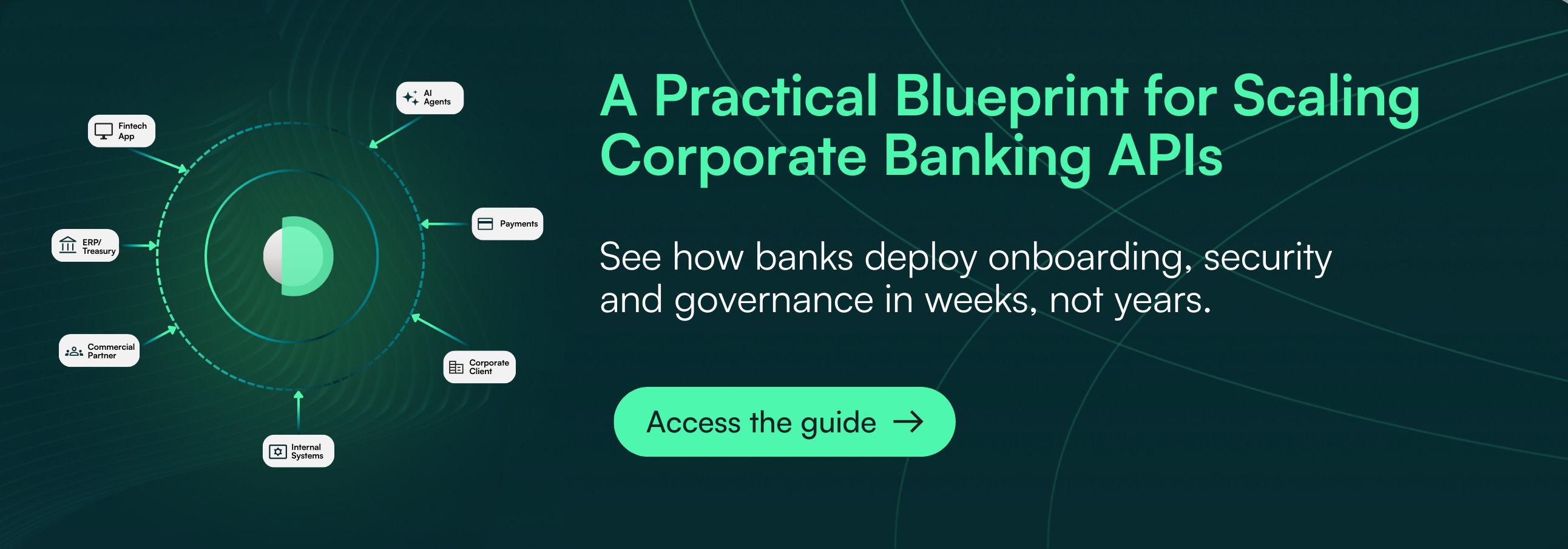
Read the long-form guide: From Exposure to Control: Operationalising API Security at Scale for Corporate Banks - a practical exploration of how banks can redesign trust, access, and governance to unlock genuine developer adoption and scalable DX.