Many corporate banks now claim to have an API strategy. Far fewer have an API distribution strategy.
Outside of regulated open banking, most corporate banking APIs still operate as bespoke integrations rather than scalable enterprise-grade products. Despite clear demand from corporate clients, fintechs, and platform partners, API programmes often stall after a small number of integrations. The limiting factor is rarely technology. It is the operating model banks use to expose APIs.
Until APIs are designed to scale as enterprise distribution channels - rather than one-off projects - they will remain expensive, slow to extend, and strategically constrained.
This gap between exposure and distribution is becoming a strategic constraint as banks look to scale ecosystem partnerships without increasing operational risk.
APIs in Corporate Banking Are Still Treated as Projects, Not Products
In corporate banking, APIs are still treated as projects, not products.
This is not a speculative claim; it is visible across the industry. Even banks with modern API gateways, developer portals and cloud-native infrastructure often rely on operating models built for relationship-led integration rather than repeatable distribution at scale.
Common characteristics of these models include:
- Manual, relationship-driven onboarding
- Per-client security and risk reviews
- Credentials issued and managed on a one-off basis
- Integration effort negotiated alongside commercial terms
This approach works when APIs are consumed by a small number of strategic partners. It does not work when APIs are expected to support dozens or hundreds of corporate clients, fintechs, and ecosystem participants.
Industry commentary increasingly highlights this challenge. Contributors writing in Finextra and other industry publications note that banks struggle to scale API programmes because onboarding remains bespoke and operationally expensive. As a result, APIs fail to behave like true platforms.
The problem is not the API itself. It is the trust and access model wrapped around it. When every new API consumer requires custom onboarding, manual approvals, and unique credentials, APIs behave like integration projects - not distribution channels.
→ Discover Now: API Security: The Definitive Guide
Why Project-Based API Models Do Not Scale
Treating APIs as projects produces predictable outcomes.
1. Marginal Cost Never Approaches Zero
Each additional consumer increases operational effort across engineering, security, compliance, and risk teams. Rather than achieving economies of scale, banks experience rising coordination and governance overhead.
This dynamic is increasingly visible in regulatory and supervisory analysis of banks’ growing external dependencies. The Bank for International Settlements has highlighted the operational and risk-management burden created by complex third-party and ecosystem relationships in financial services.
2. Time-to-Integration Becomes a Competitive Disadvantage
Corporate clients now expect integration experiences closer to those offered by fintech and SaaS providers.
However, fragmented onboarding, inconsistent security models, and manual approval processes significantly extend time-to-integration. The OECD has repeatedly observed that such governance fragmentation inhibits digital platform adoption and cross-border innovation in financial services.
3. Banks Constrain Access to High-Value Services
When onboarding and access decisions remain manual, risk teams naturally limit scope.
As a result, APIs are often restricted to low-risk or informational use cases, while commercially valuable workflows remain locked behind bespoke integrations. This pattern is increasingly discussed as part of broader ecosystem-governance and third-party-risk debates across the industry.
The result is familiar: APIs exist, demand exists, but distribution never scales.
What Scalable API Distribution Looks Like
By contrast, sectors where APIs are genuine Distribution Channels - including Cloud Platforms, Payments Infrastructure, and Digital Marketplaces - share a common characteristic. Trust, Identity, and Access are designed as repeatable systems, not negotiated per relationship.
Crucially, this approach increases control as ecosystems scale, rather than diluting it.
Onboarding is:
- Standardised
- Automated where possible
- Centrally governed
- Designed to support scale from the outset
Without this shift, Corporate Banks risk modernising API exposure while preserving legacy Distribution Economics.
→ Discover Now - Developer Guide: Onboarding Your First Partner in Just 30 Days
The Next Phase of API Strategy for Corporate Banking
If APIs are intended to be more than integration points - if they are meant to function as scalable distribution channels - then the operating model matters as much as the technology.
Enterprise and corporate banking leaders should be asking:
- Is API onboarding designed for repeatability or exception handling?
- Can access decisions be automated and governed centrally?
- Does marginal cost fall as API adoption grows?
These questions sit at the heart of the next phase of corporate API strategy.
Ready to Turn Your APIs Into Real Distribution Channels?
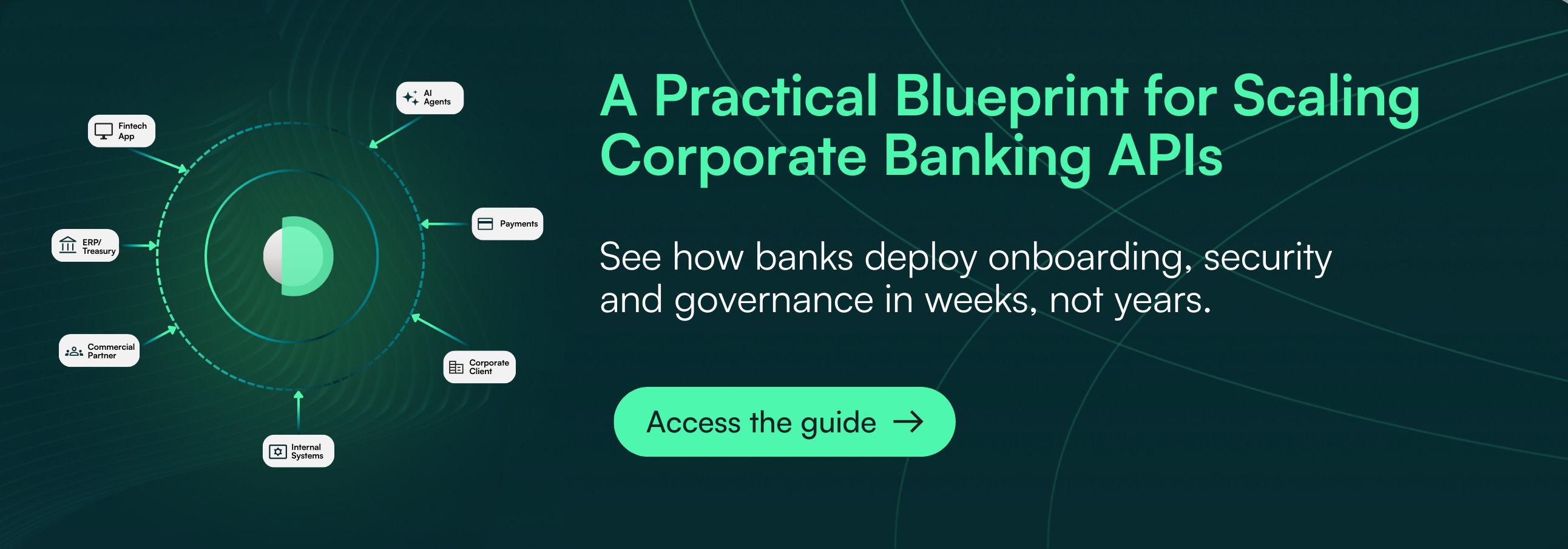
Read the long-form guide: Scaling Corporate Banking APIs Without Slowing Growth - an in-depth exploration of how banks can redesign trust, access, and governance to turn APIs into real distribution channels.