Release Notes

Full changelog for all Raidiam Connect versions.

⚠️

Upcoming Breaking Changes

Future changes that may require action on your end. Review and plan ahead.

"Withdrawn" status renamed to "Inactive" for Organisations

Q1 2027

The Withdrawn status value for Organisations will be renamed to Inactive. This is a nomenclature change only. The behaviour and meaning of the status remain unchanged.

A transition period of approximately 3 months will be provided before the change takes effect. Any integration that reads or compares the Organisation status value as a string should be updated to handle Inactive in place of Withdrawn.

✨

Coming soon

Improvements and new features on the way. No action needed on your end.

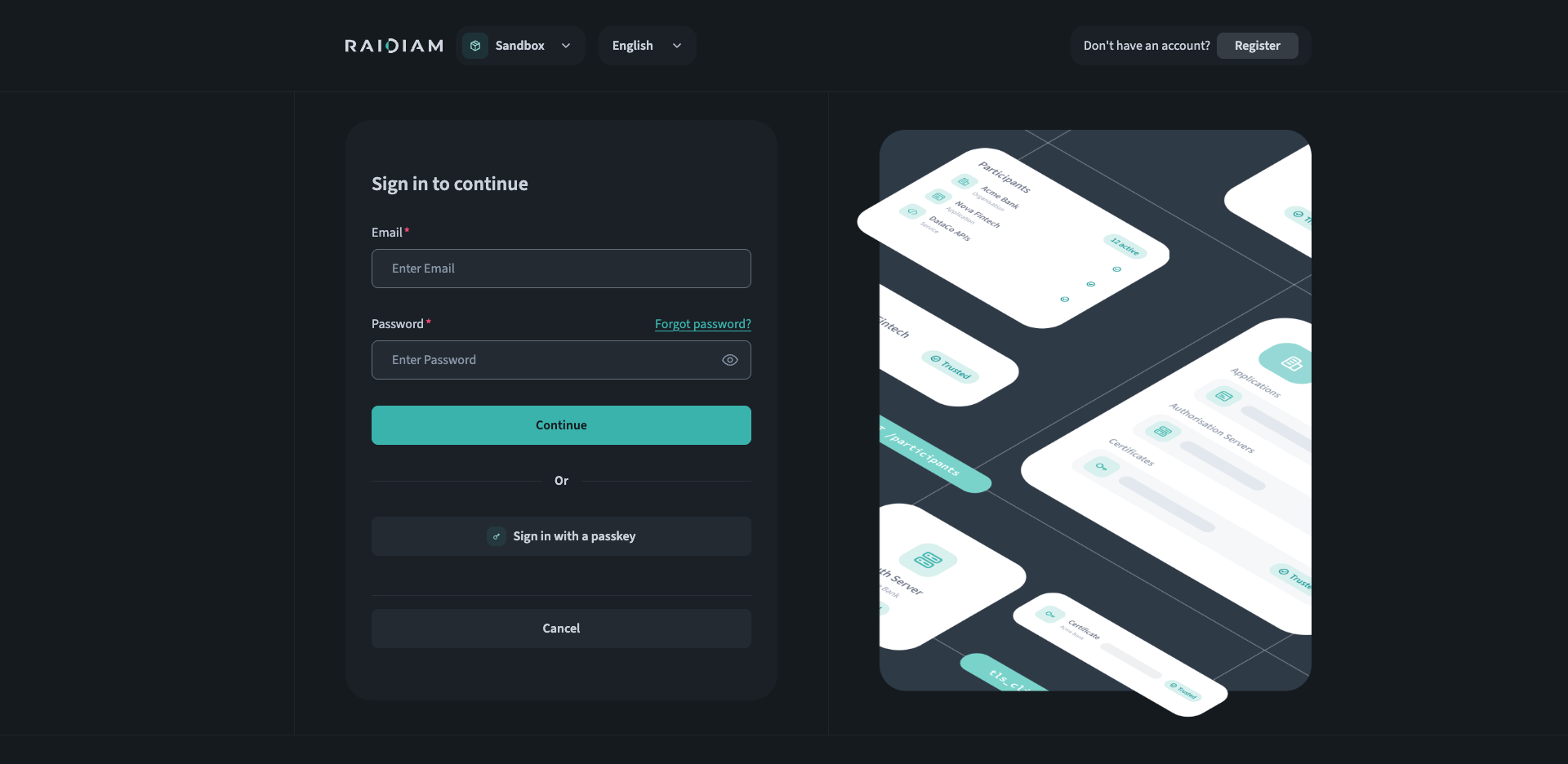
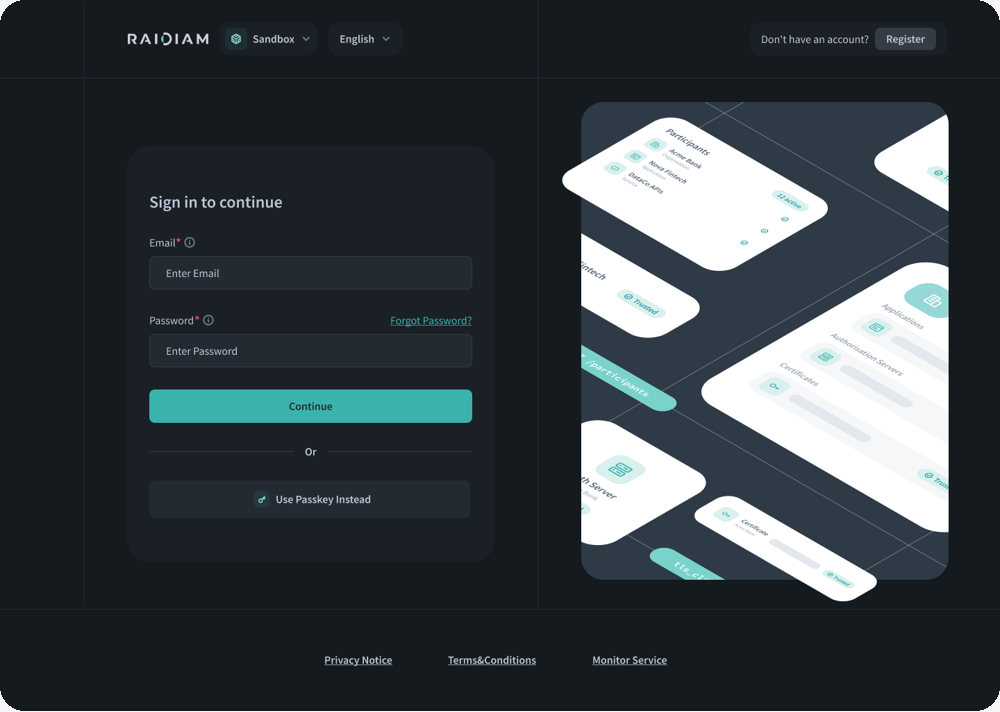
Security upgrade to the sign-in screens, with passkeys

New Feature

We are upgrading the security of the sign-in and consent screens. New security capabilities needed changes to these screens, and to reduce the attack surface we are standardising the layout across ecosystems, with fewer customisation variants. Each ecosystem keeps its logo and brand colour on a common, more secure layout.

Passkeys: users can sign in with their device's fingerprint, face or screen lock instead of a password. Passkeys are available by default, and ecosystems can opt out.

What does not change: the steps users follow, the information shown, terms and policy links, and all integrations and configuration.

Release dates will be confirmed with each ecosystem. The screens below show the Raidiam brand.

Security upgrade to the sign-in screens, with passkeys
Compare versions:→

3.0.0#

Latest↓ Download Swagger▾

This release introduces expanded identity federation and trust capabilities, centralised key and certificate management, and strengthened authorisation and audit controls. It also delivers broad usability and interface improvements across onboarding, lifecycle management and administration workflows, alongside fixes addressing access scoping, validation consistency, notification delivery and navigation behaviour.

Breaking changes#

Cascade delete, restore, enable and disable standardised for organisations, applications and servers

Breaking Change

Deleting, restoring, enabling and disabling now work the same way across organisations, applications and authorisation servers.

  • Deletes can now cascade to sub-resources when needed: a confirmation dialog lists exactly which sub-resources will be inactivated, and the delete stays disabled until the user acknowledges it
  • Through the API, deleting an application that still has active certifications without the cascade option is now rejected with a 400 response, matching authorisation servers
  • Super Users and Data Administrators can restore soft-deleted organisations, applications and authorisation servers from their list and details pages, with a confirmation step and an Active status shown on success
  • Authorisation servers can now be disabled and enabled like applications, with a confirmation prompt and a clear Active indicator
Domain role lookups now use identifiers

Breaking Change

Authorisation domain roles are now looked up within their domain by their unique role identifier, instead of by role name.

  • Roles with the same name in different domains no longer collide
  • Role details and the directory interface now use the correct domain and role identifier
Note: If you call the API to look up domain roles, update your calls to the new domain-scoped path.

Stricter extended key usage validation for CSRs

Breaking Change

Certificate profiles can now require any extended key usage, and certificate signing requests carrying usages the profile does not list are rejected.

  • Profiles can require extended key usages in any order, for example the ISO/IEC 18013-5 document signer, reader authentication and VICAL signer usages
  • When a profile sets required or allowed usages, a signing request with any other extended key usage is now rejected where it was previously accepted
Note: If you generate your own signing requests, make sure they only carry the extended key usages declared by your certificate profile.

Federation metadata contacts filtered by contact type

Breaking Change

Published OpenID Federation entity configurations now only include federation contacts.

  • Only contacts with the federation contact type are published
  • Administrator and other contact types are no longer exposed in public metadata
  • Entities with no federation contact no longer publish a contacts entry at all
Note: If you rely on contact addresses previously published in federation metadata, update your configuration.

Audit endpoint enforces pagination limits

Breaking Change

The audit history API now enforces pagination limits.

  • Page size and page number are validated, and a maximum page size is enforced
  • Invalid or out-of-range values are rejected with a 400 Bad Request
  • Behaviour when no pagination is requested is unchanged
Note: If you request very large pages, page through the results using the sizes documented in the API specification.

Organisation certificate description can no longer be updated

Breaking Change

The PUT /organisations/{OrganisationId}/certificates/{OrganisationCertificateType} endpoint, which was used to update an organisation certificate's description, has been removed. Certificates themselves are not removed and continue to work as before. Revocation remains available via PUT /organisations/{OrganisationId}/certificates/kid/{CertificateOrKeyId}.

New features#

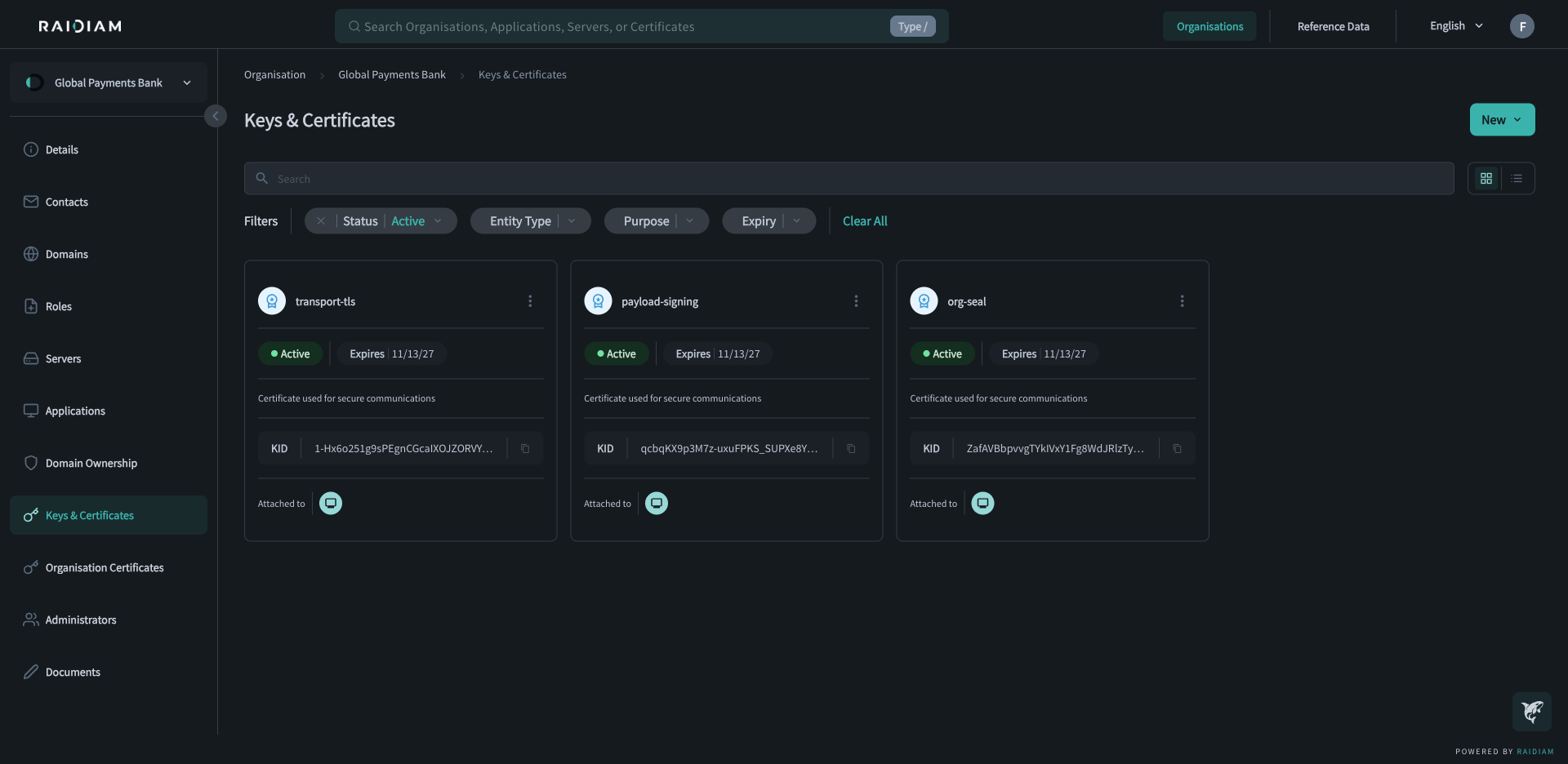
New Keys and Certificates management

New Feature

A new Keys and Certificates section brings an organisation's keys, public keys and certificates together in one place.

  • Browse everything in list or card view, with search and filters
  • Each item has a detail screen with its type, identifier, status, dates and raw material, where it is attached (applications, servers, authorities) and for what purpose, plus its own audit history
  • Guided wizards upload certificates and public key material, attach them and assign purposes
  • Revoke keys and certificates from the list or the detail screen
  • Upload a certificate once at organisation level and reuse it across eligible applications, servers and organisations
New Keys and Certificates management

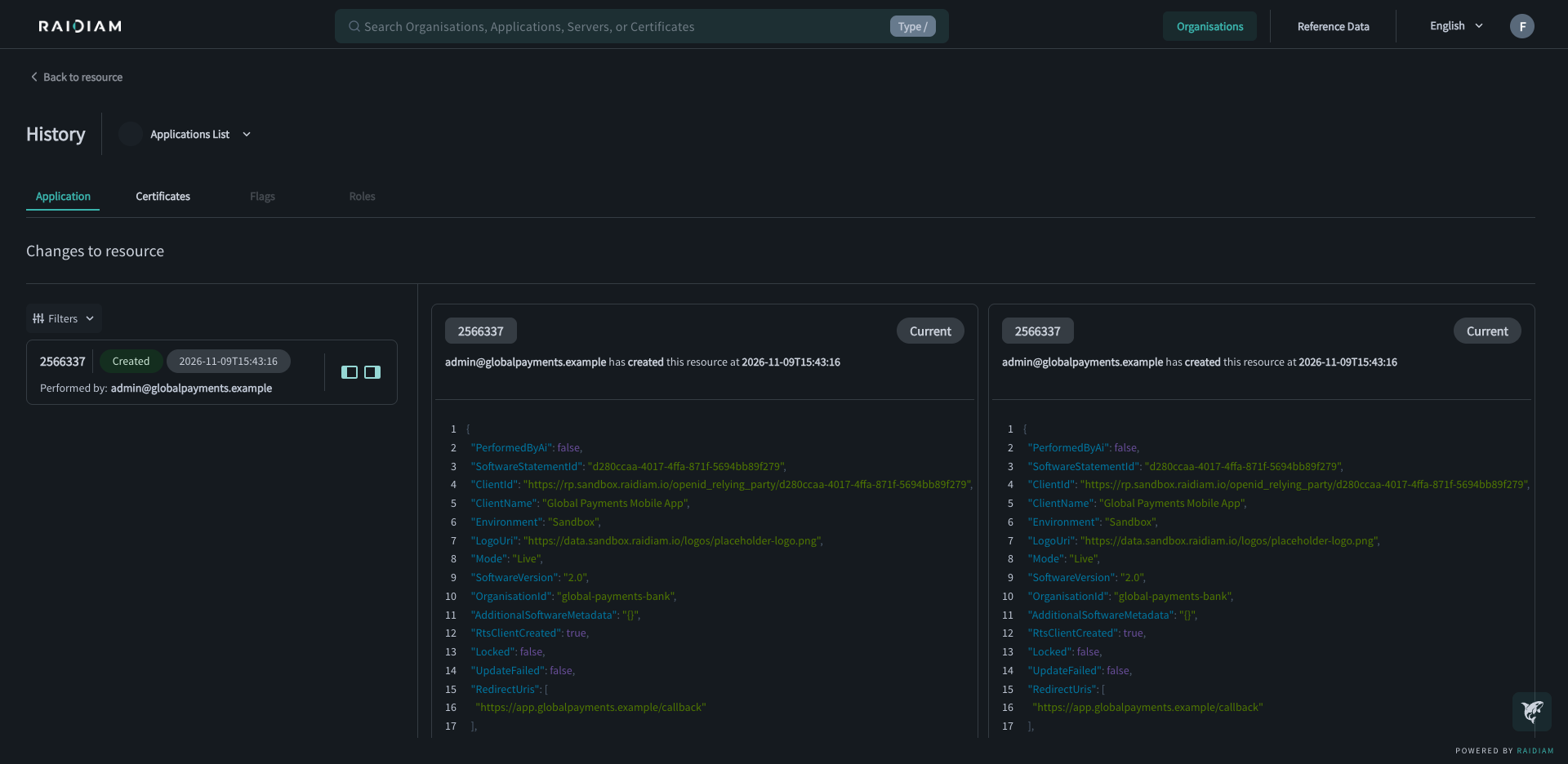
Change history for authorisation servers, certifications and roles

New Feature

Authorisation servers, their certifications and their roles now have a change history.

  • See created, updated and deleted events, with the user who made each change
  • Filter by action type, organisation and period
  • Switch between servers, certifications and roles from the history view
Change history for authorisation servers, certifications and roles

Application-level role exclusivity

New Feature

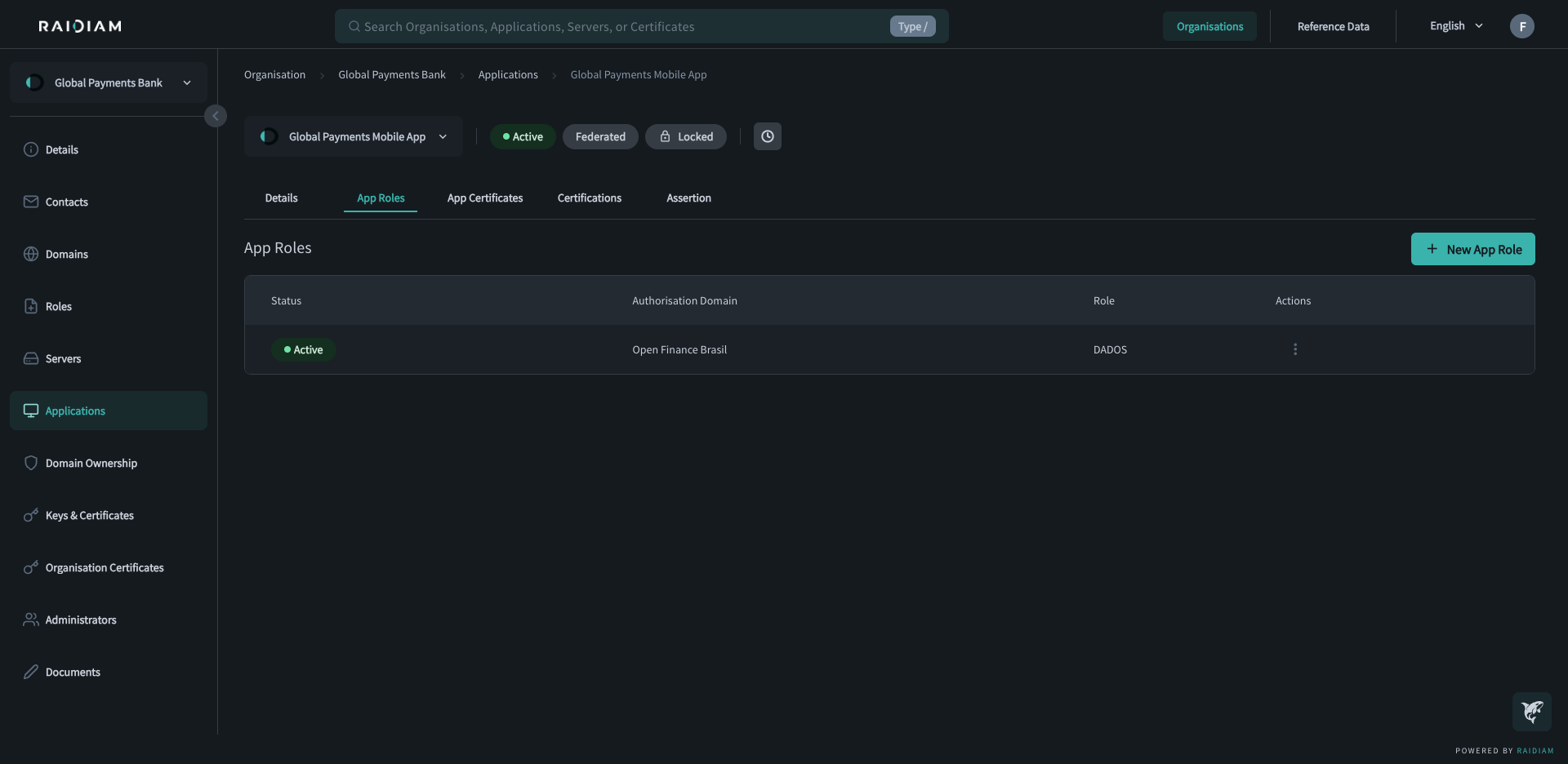
Role exclusivity can now be enforced at the application level, so an application cannot hold more than one exclusive role.

  • Super Users switch it on with a new toggle in Reference Data
  • Conflicting role assignments are rejected with clear messages in both the interface and the API
  • The application-level toggle is hidden while organisation-level exclusivity is active
Application-level role exclusivity

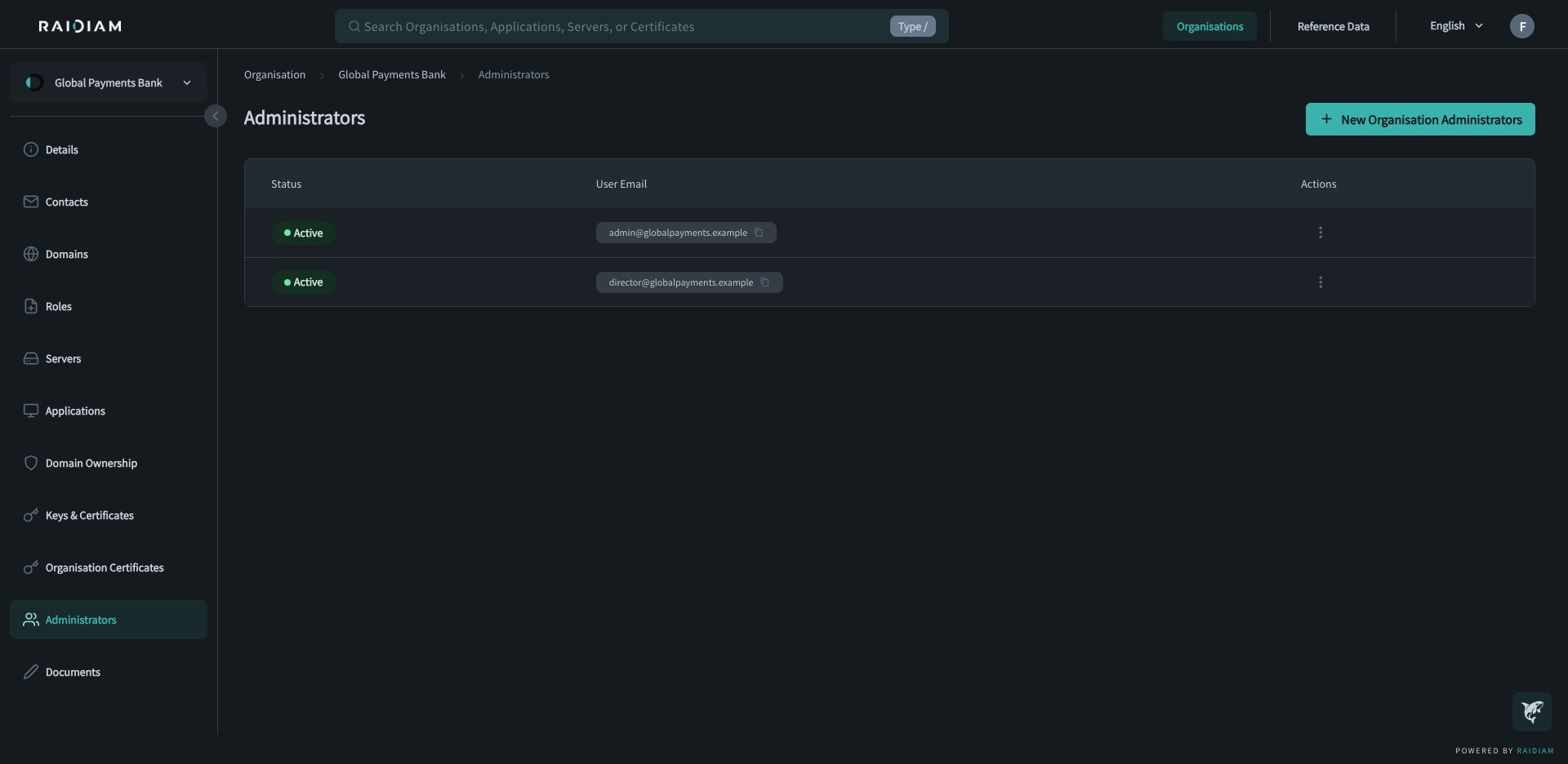
Unified Users page for administrator roles

New Feature

Reference Data now has a single Users page for administrator roles.

  • Separate tabs for Super Users, Data Administrators and Certification Managers
  • Create and disable each of these user types from one place
  • Certification Managers can be created from the interface for the first time
Unified Users page for administrator roles

Configurable client assertion type header per provider

New Feature

Single sign-on providers can now set the type header of the client authentication assertion sent to them.

  • A new optional setting in the single sign-on configuration API sets the type header of the private_key_jwt assertion sent to a federated provider
  • When the setting is left empty the current value is still sent, so existing providers are unaffected

Multiple sign-in providers per email address

New Feature

The sign-in screen now supports several identity providers for the same email address.

  • One button per provider when there are only a few, and a selector when there are many
  • Ecosystems can be set to SSO-only, hiding password sign-in, or SSO-preferred, de-emphasising it
  • Layouts are optimised for desktop and mobile

Passkeys prompt available across all brands

New Feature

Passkeys can now be offered to end users for passwordless authentication.

  • The passkeys prompt is available for every brand
  • Passkeys are enabled by default
Passkeys prompt available across all brands

Enhancements#

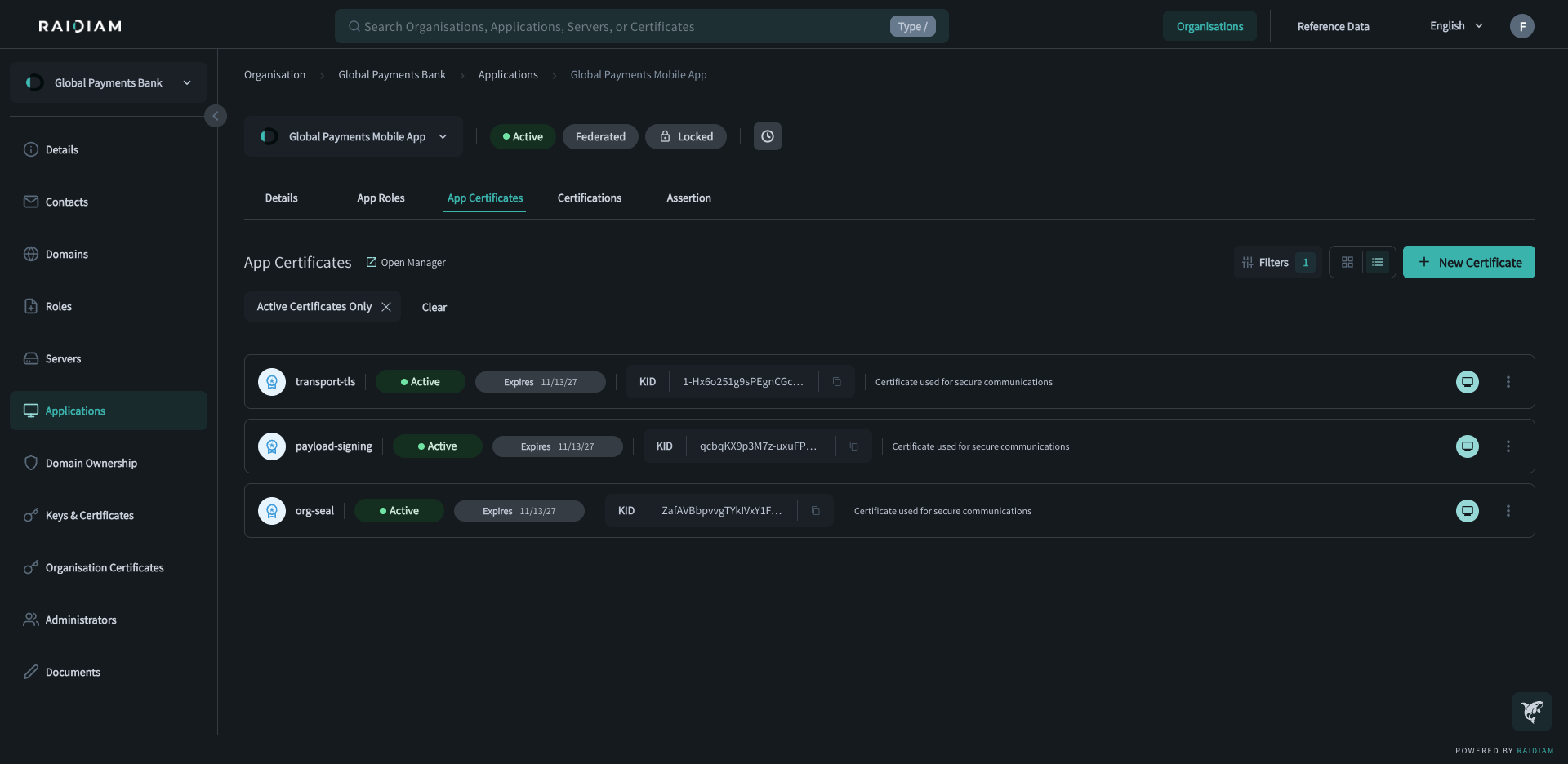
Application and server certificate pages aligned

Enhancement

Application and server certificate pages now match the new Keys and Certificates section.

  • Toggle between card and list view, and the choice is remembered between sessions
  • An Open Manager shortcut takes you to the central Keys and Certificates screen
  • Certificates added from an application or server page also appear in the central manager
Application and server certificate pages aligned

Richer directory values in subordinate statements

Enhancement

Subordinate statements issued for federation entities now include more values held by the directory.

  • Adds the JWKS URI, client name, software version and issuer
  • Relying parties get more trustworthy metadata directly from the federation chain

Bug fixes#

Certificate signing request commands corrected for several profiles

Bug Fix

The OpenSSL commands, instructions and configuration files generated for several certificate profiles now produce signing requests that pass validation.

  • Commands follow each profile's naming constraints
  • Distinguished name attributes are placed in the subject, and organisation identifiers include their required prefix
  • Required subject fields, such as the common name, are captured before submission
  • A Linux configuration file is now available where it was missing

Audit entries record the correct user and time

Bug Fix

Audit entries now record the correct user and time.

  • The acting user is taken from the signed-in session
  • Deletion entries record the correct timestamp and actor

Authority and authorisation domain dropdowns load correctly

Bug Fix

The authority and authorisation domain dropdowns now load correctly.

  • Options load once, without repeated paging requests
  • Stale options are no longer shown after a change

Email delivery continues despite invalid recipients

Bug Fix

Notification emails now reach all valid recipients even when one address is invalid.

  • An invalid address no longer stops the whole send
  • Delivery outcomes and validation failures are recorded with accurate detail, to speed up diagnosis

Email identity resolution now uses exact matching

Bug Fix

Finding a user by email address now requires an exact match.

  • Email matching is case insensitive but exact, instead of a pattern match
  • Wildcard characters are rejected in email address fields, so an organisation administrator can no longer find or assign roles to an unrelated user with a wildcard value

Issuer destination validation on authorisation servers

Bug Fix

Issuer values on authorisation servers are now checked before the directory fetches their discovery document.

  • Loopback, link-local and private network addresses are rejected when creating or updating a server
  • This closes a path that allowed internal network reachability to be probed

Audit endpoint organisation parameter handling corrected

Bug Fix

Audit history can no longer be read across organisations by repeating the organisation parameter.

  • The organisation is resolved the same way for the permission check and for the data returned
  • Requests that repeat the organisation parameter are rejected

Client identifier rename now synchronises transactionally

Bug Fix

Renaming the client identifier of a self-managed federation software statement now updates the OpenID Provider in the same operation.

  • The previous client registration is removed as part of the rename, and the rename is rolled back if that fails
  • This prevents orphaned client registrations and identifiers that could never be reused

All DNS names in CSRs now validated

Bug Fix

Every DNS name in a certificate signing request is now checked against the PKI profile.

  • The profile's DNS name rules apply to every subject alternative name, not only the first
  • Additional DNS names can no longer bypass the profile and end up in an issued certificate

Authority claim access scoped to owning statement

Bug Fix

Software authority claims can now only be read or updated through the software statement and organisation they belong to.

  • Another participant's regulatory role claim can no longer be read, activated or deactivated through a path you own

Authority claims now return domain identifier

Bug Fix

Authority claim responses now include the authorisation domain identifier.

  • Organisation and software statement authority claims return the domain identifier alongside the deprecated domain name
  • This makes the documented move from domain name to domain identifier possible, and existing integrations are unaffected

Accurate federation resolve error reporting

Bug Fix

Federation resolve errors now report the real reason.

  • Metadata validation failures are no longer reported as entity configuration retrieval failures
  • The error description includes the underlying validation reason, so you are no longer sent to debug network issues that do not exist

Federation responses now return correct CORS headers

Bug Fix

Federation responses now always return the correct cross-origin headers.

  • Cached responses could be served without cross-origin headers, so browser-based clients were refused depending on which request filled the cache
  • Browser and server-side callers now each receive the correct response

Localhost accepted for backchannel notification endpoint

Bug Fix

The Backchannel Client Notification Endpoint field in the Software Statement wizard now accepts any HTTPS URL, including localhost.

  • Matches the validation the API already applies
  • Unblocks sandbox and local CIBA testing setups

Corrected certification URI description typo

Bug Fix

A typo in the certification URI description in the published API specification is corrected.

  • The field's behaviour is unchanged

Certificate wizard supports accented subject values

Bug Fix

The certificate wizard now supports accented and other special characters in subject alternative name values.

  • Accented characters, underscores and other special characters work in both the generated OpenSSL command and the downloadable configuration file
  • Signing requests can now be generated for names such as "João Conceição"

Client secret shown when updating authentication

Bug Fix

Switching a software statement to client secret authentication now shows the generated secret.

  • Changing from private key JWT to client secret basic opens the dialog with the new client secret
  • No secret dialog is shown when switching to other methods or when the method is unchanged

Certificate wizard shows friendly profile names

Bug Fix

The certificate wizard now shows readable certificate profile names.

  • The profile dropdown shows display names instead of technical profile keys
  • Names come from the platform, so they are consistent across environments

Domain role selection and search fixed

Bug Fix

Adding domain roles in the organisation wizard now works reliably.

  • Redundant authorisation domain requests, which could return server errors, are no longer made
  • Role search results are now displayed correctly

API Resources tab hidden where unsupported

Bug Fix

The API Resources view no longer shows a permissions error where it is not available.

  • The tab can be hidden through configuration, so users only see views their ecosystem supports

Certification tags open correct server tab

Bug Fix

Server certification tags now open the right tab.

  • Selecting a certification tag on the server details page opens the Server Certifications tab instead of the Roles tab

Dropdowns inside dialogs display correctly

Bug Fix

Dropdowns inside dialogs now display correctly.

  • Options no longer render behind the dialog or add a second scrollbar
  • All options are fully visible and selectable

Client ID tooltip shows translated text

Bug Fix

The Client ID tooltip in the Software Statement wizard now shows the right text.

  • With self-managed federation it previously showed an untranslated placeholder
  • The correct text now shows for every brand and language

Developer Portal URI no longer marked required

Bug Fix

The Developer Portal URI field on the Edit Server screen is no longer marked as required.

  • The field was always optional, and the indicator now matches its validation

Audit pages now block unauthorised access

Bug Fix

Audit pages now show a clear message to users without permission.

  • Users without access to an organisation's audit data see a forbidden state instead of an empty page with a generic error
  • Applies to organisation, certificate, authority domain claim and software statement audit views

Withdrawn authority domain claims can no longer be reinstated

Bug Fix

Authority domain claims withdrawn by an authority can no longer be reinstated by an organisation administrator.

  • Only the authority can now restore a withdrawn domain claim

Search ignores leading and trailing spaces

Bug Fix

Search now ignores leading and trailing spaces.

  • An accidental or pasted space no longer makes a valid record look missing
  • Applies to global navigation, Software Statements and Reference Data search

Authorisation server creation confirmation now appears

Bug Fix

The success confirmation now appears after creating an authorisation server with a logo warning.

  • Dismissing the logo warning now shows the confirmation with the View shortcut
  • Previously there was no feedback, even though the server had been created

Onboarding webhook validates notification source

Bug Fix

The software statement onboarding webhook now checks where notifications come from.

  • Only notifications from the expected source are accepted, not any validly signed message
  • Unauthorised callers can no longer obtain a signed software statement assertion or trigger a client registration

Fix role claim deactivation across authorities

Bug Fix

Deactivating an authority domain role claim no longer fails when another authority holds the same role on the same domain.

  • The check is now scoped to the specific authority and role claim
  • Organisations can be moved between authorities that share a domain

Domain user access now organisation bound

Bug Fix

Domain users can now only see and act on their own organisation's documents.

  • Users with read-type access could previously view and act on terms and conditions and organisation documents of other organisations
  • Access is now scoped to the user's own organisation, along with smaller fixes in the same area

2.4.0#

▾

2.3.0#

▾

2.2.0#

▾

2.1.0#

▾

2.0.0#

▾